PCE Instruments PCE-EVSE 310+ Automotive testers for VDE 0100 checks and charging points for electric cars
(Incl. Tax: €467.32)
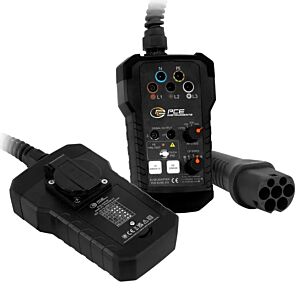
The PCE-EVSE 310+ is a professional tester for checking wallboxes, charging stations and electric vehicle charging points according to VDE 0100. It simulates vehicle connection, verifies functionality, safety, station response and possible EVSE infrastructure faults. Ideal for installers, electricians, maintenance technicians, commissioning specialists and electric mobility professionals.

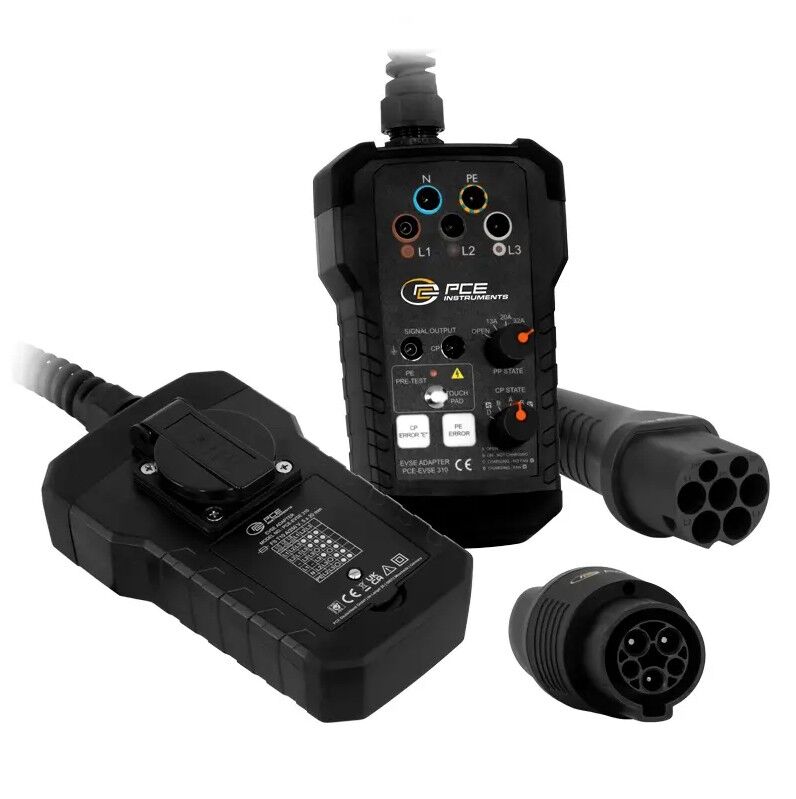
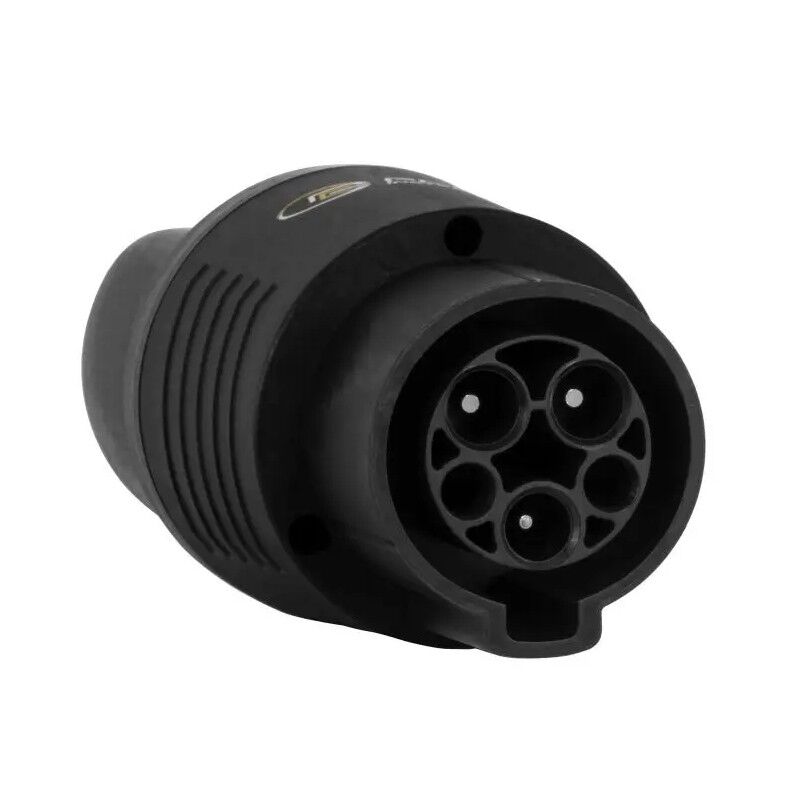
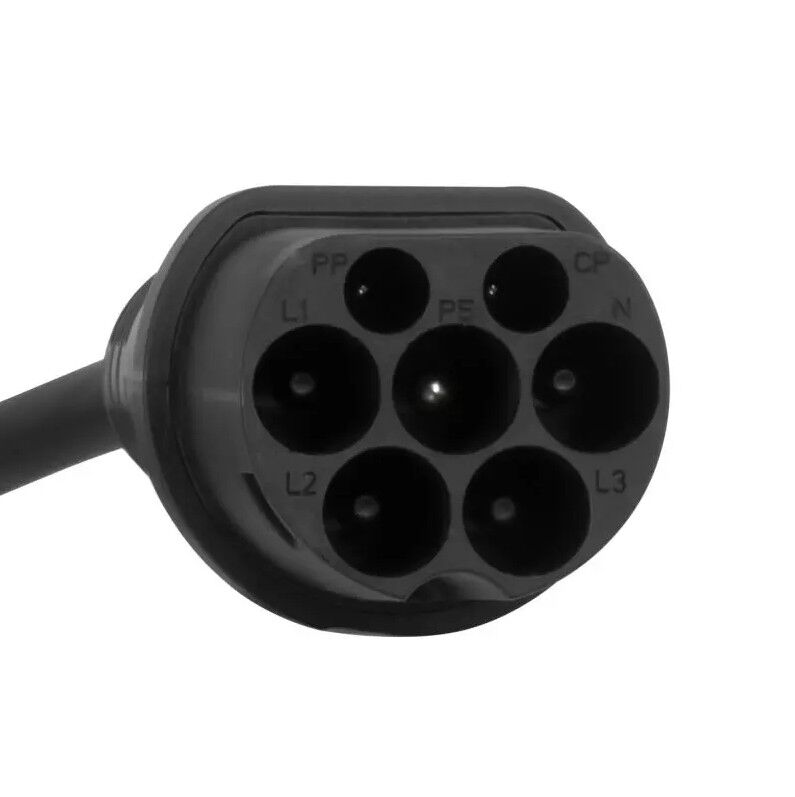
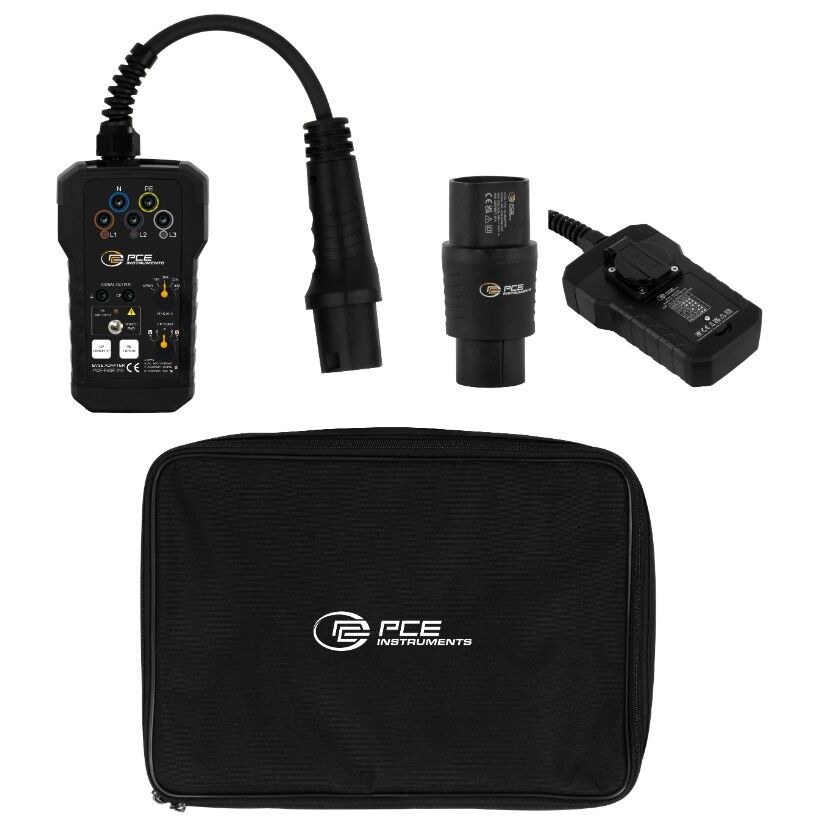
The PCE-EVSE 310+ is a professional tester designed for checking electric vehicle charging points and for technical inspections of electrical installations according to VDE 0100 requirements. It is intended for electricians, installers, maintenance technicians, commissioning specialists, engineers and professionals who need to check wallboxes, charging stations and EVSE infrastructures safely, systematically and repeatably. Its main function is to verify the correct operation of the charging station by simulating the operating conditions that normally occur when an electric vehicle is connected to the charging point.
In the field of electric mobility, a charging station must not simply deliver current. It must correctly manage the connection with the vehicle, recognise the charging status, enable power only when the correct conditions are present and interrupt the process in the event of a fault. The PCE-EVSE 310+ allows the technician to simulate these conditions without necessarily using a real electric car. This makes it possible to check the behaviour of the wallbox or charging station during the different stages of connection, charging authorisation, operation and safety control.
The reference to VDE 0100 is important because it relates to the verification of low-voltage electrical installations and the safety requirements associated with installation. In the case of electric vehicle charging points, the inspection must consider not only the presence of voltage, but also correct wiring, continuity of the protective conductor, safe earthing, response of protective devices, insulation and behaviour of the station under real operating conditions. The PCE-EVSE 310+ is therefore useful for checking that the charging point has been installed correctly and can operate safely for the user, the vehicle and the upstream electrical system.
During initial commissioning, the instrument makes it possible to check whether the charging station correctly recognises the connection, enables charging according to the expected sequence and does not show obvious installation or operating errors. This stage is essential when a new wallbox is installed in a home, garage, company, car park, workshop, hotel, commercial area or public location. A technical check carried out with a dedicated instrument allows the system to be handed over with greater safety and with a more professional verification than a simple visual inspection.
In preventive maintenance, the PCE-EVSE 310+ can be used to periodically check already installed charging points, verifying that the station continues to respond correctly and that there are no signs of malfunction. Charging infrastructures are subject to repeated use, environmental variations, connector wear, possible impacts, electrical stress, installation changes and maintenance work. Periodic checks make it possible to identify anomalies before they cause service downtime, customer complaints or safety risks.
In corrective maintenance and fault diagnosis, the tester is particularly useful when the charging station does not start charging, interrupts the process, reports an error, does not recognise the vehicle or behaves irregularly. The technician can use the instrument to determine whether the problem is related to the charging station, wiring, protection circuit, communication between vehicle and charging point, earthing or the supply installation. This reduces troubleshooting time and allows more targeted interventions, avoiding unnecessary replacements or checks performed without a precise method.
The accuracy and resolution of the instrument are important because they allow reliable evaluation of charging functionality and controlled electrical conditions. In a professional application, it is not enough to know whether the charging station “works” or “does not work”; it is necessary to verify whether the response is consistent, whether parameters are stable and whether safety conditions are respected. Accuracy indicates the instrument’s ability to provide a reliable check, while resolution makes it possible to distinguish variations or operating states that may be significant during diagnosis.
The PCE-EVSE 310+ is suitable for applications related to electric mobility, charging infrastructures and electrical systems connected to wallboxes and charging stations. It can be used in residential, industrial, commercial, public, corporate and technical environments. It is suitable for installers verifying new installations, maintenance technicians checking existing systems, laboratories performing functional tests, companies managing electric fleets and technicians working on charging points in professional contexts.
From a practical point of view, before carrying out a test it is important to check the type of charging point, installation characteristics, installed protection system, supply voltage, connection type, cable condition and operating conditions. The test must be performed methodically, following electrical safety procedures and using the instrument consistently with the application. It is advisable to record test conditions, inspection results, any detected anomalies and performed interventions, especially when the test is part of scheduled maintenance or documented verification.
The connection with heights, transmission backlash, form errors and geometry is indirect but may be relevant in the physical installation of charging infrastructures. The PCE-EVSE 310+ does not measure mechanical dimensions, play or geometric errors, but the correct operation of a charging station may also depend on the quality of the physical installation: wallbox mounting height, connector position, correct fixing, absence of mechanical stress on the cable, impact protection, correct cable routing and support stability. A poorly installed charging point can cause connector wear, abnormal cable tension, infiltration, mechanical damage or contact problems that may eventually affect electrical safety.
In industrial and corporate applications, where several charging points may be present, the instrument allows the inspection method to be standardised and each charging station to be checked using the same procedure. This is useful in company car parks, electric fleets, workshops, dealerships, public facilities, hotels, shopping centres and production areas where charging service continuity is important. The ability to detect errors and check the station’s behaviour improves the quality of technical assistance and provides a more professional service to the end customer.
Tadaah presents the PCE-EVSE 310+ as a technical instrument for professionals in the electrical and electric mobility sectors who need to verify charging points reliably, safely and in a documentable way. Choosing a dedicated tester improves commissioning, preventive maintenance, fault diagnosis, quality control and safety of EVSE infrastructures. It is particularly useful for those who want to work methodically on wallboxes and charging stations, reducing the risk of errors, improving intervention quality and demonstrating technical competence in electric vehicle charging systems.
Features:
- PE pre-test
- Status of the Proximity Pilot PP and the Control Pilot CP
- Simulation of CP fault "E" and PE fault
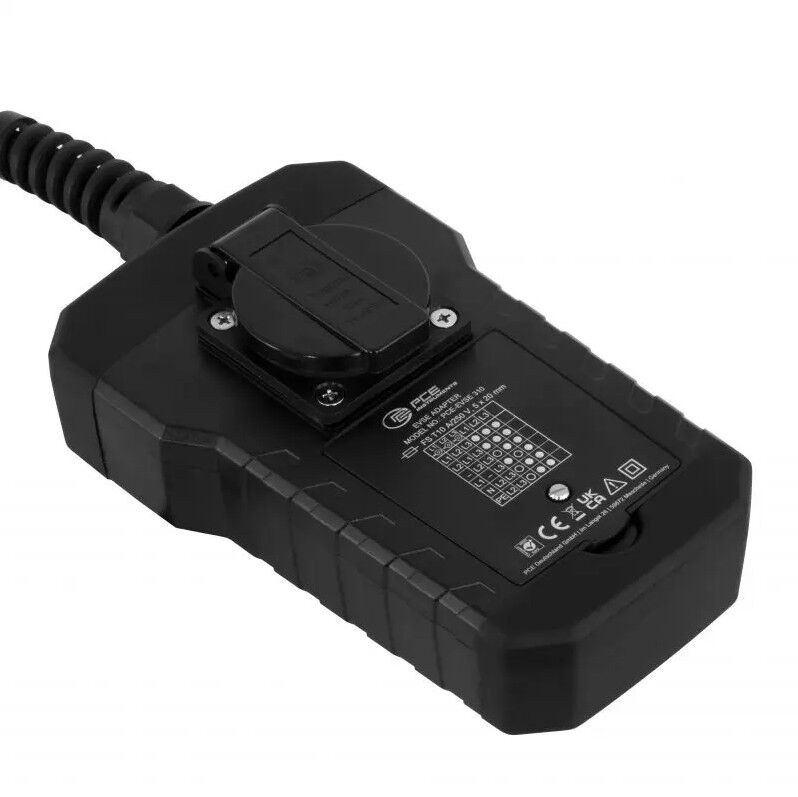
- Mains socket for measuring purposes
- Safety measuring sockets
- incl. adapter to type 1
- incl. type 2 plug
Delivery scope:
1 x EV Test Instrument PCE-EVSE 310+
1 x operating instructions
1 x transport bag
1 x type 2 plug
1 x adapter to type 1 (PCE-EVSE ADP)
Technical Data:
| Test Functions | |
| PE pre-test | yes, with capacitive electrode |
| PP Simulation | open, 13 A, 20 A, 32 A, 63 A |
| CP Status | A, B, C, D |
| CP error "E" | E |
| PE fault / earth fault | Yes |
| General technical data | |
| Connections | L1, L2, L3, N, PE |
| Connections Additional information | max. 230V (1-phase) / 430V (3-phase) ; 50 / 60Hz 10A / 250 V Type 2 plug fixed to the cable (optional adapter required for type 1) |
| Standard(s) | IEC62196-2 Type 2 connector |
| Cable length | 25 cm |
| Safety standard | CAT II / 300V |
| Power socket | max. 250 V; 50/60 Hz; 10 A |
| Outputs | 2 x 4mm sockets (signal output terminals) |
| Fuse(s) | Power socket T10A/250V |
| Protection class (device) | IP40 |
| Weight | 643 g |
| Dimensions (L x W x H) | 600 x 105 x 73 mm |
| Operating conditions | 0 - 40 °C , 80 % r.H. |
| Storage conditions | -10 - 50 °C , 80 % r.F |
| Languages of instructions | German, English |
- Typology:
- Multifunctional
- Brand:
- PCE INSTRUMENTS