9142E Main Collet ROUND for Multi Spindle Lathes Wickman 2 1/4"- 6M, Mori-Say 57.
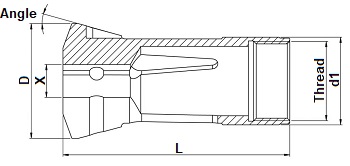
The Main collet , installed in the lathe spindles for clamping bars or workpieces during operations such as turning and drilling, operates through an axial movement of the drawbar, which generates strong closing pressure between the cone and the contact sleeve with the bar. Collet chucks are used on various lathes (automatic, CNC, multi-spindle); the HM-coated versions provide a 50% higher frontal clamping load but are not recommended for unturned bars or when there are concentricity tolerances between the unturned bar and the machined part. Tadaah collets ensure precision, durability, and optimal clamping force thanks to high-quality materials and can be customized to meet specific requirements. Bar gripping collets deliver maximum performance when used with drawn bars of constant diameter for a perfect grip.

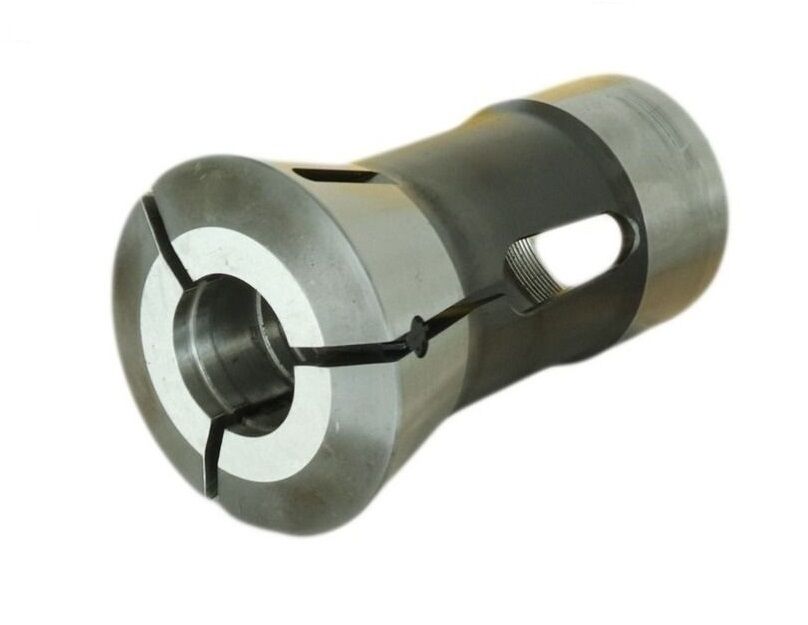
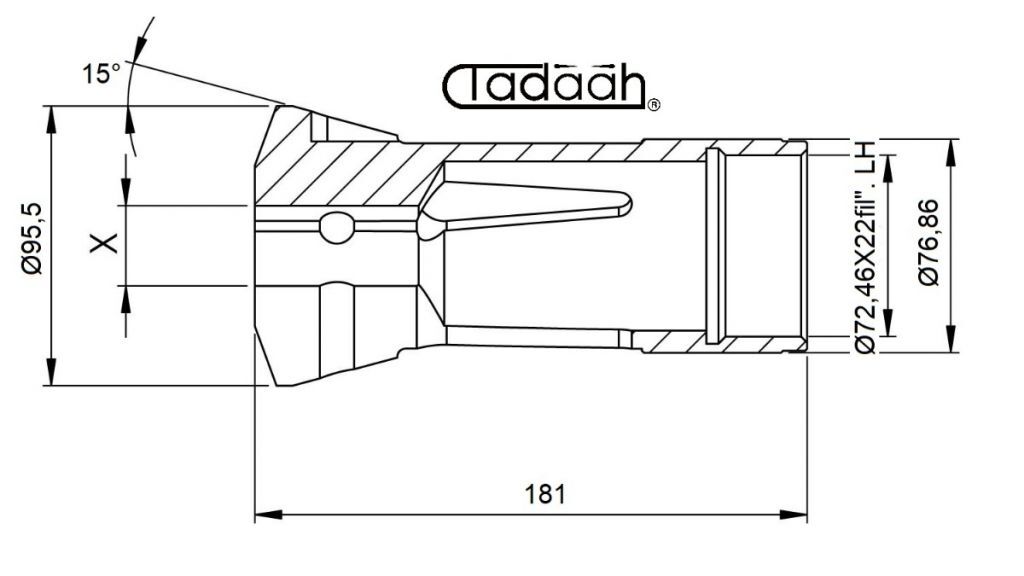
Clamping faces can be tungsten carbide hard coated. Giving a frontal closing load approx. 50% higher than uncoated as well as extending the life of the collet.
What is a Main collet clamp?
The main collet clamp is a tool that is mounted inside the spindles of a lathe and is used to clamp the bar or workpiece during the execution of a turning or drilling operation using cutting tools.
Area of use:
Automatic cam lathes, multispindle, CNC lathes, sliding headstock lathes, fixed headstock lathes, lathes with machining from bar, machining of workpieces in resumption, component assembly,
How a gripper works
Its clamping and opening operation is achieved through the axial displacement of a tie rod, usually called a main collet clamp, which, through axial sliding, when the collet cone acts on the spindle cone, forcing a tensile or compressive force, generates a considerable load on the bar clamp ensuring a strong clamping for closing the workpiece or bar.
The Main collet clamp is made according to the diameter of the bar to be machined, which is normally a drawn bar, as the cone of the collet exerts considerable pressure on the cone, but the bar clamping rod has a limited radial stroke. Only a constant bar diameter can guarantee perfect clamping and a constant clamping force.
The axial sliding of the clamping rod can be effected by means of mechanical cams, lugs or hammers and pneumatic or hydraulic movement.
Pulling collet clamps
Pulling collet clamps have a thread at the rear of the cone, which can be either external or internal. The thread serves to secure the clamp to the clamping rod, which determines the opening or closing of the clamp during its axial movement.
The main features and qualities of a main collet bar clamp supplied by Tadaah are:
Clamp material that guarantees the quality of the clamp over time
Caliper construction with very low geometry and oscillation errors
Maintaining the precision of the main collet clamp over time
Significant clamping force on the cone to prevent the bar from retracting during machining and to take full advantage of the cutting characteristics and parameters of the tools
Main collet in according to drawing
Tadaah's main collet clamp can also be made to drawings at the customer's request. Customisation can be carried out for functional advantages, space problems or if the customer has designed a gripper with custom dimensions for special technical specifications.
We also make the collet clamps according to Tadaah specifications to ensure a higher clamping load and to avoid bar backlash during machining.

The collets will be supplied according to the available profiles, if you need a particular profile write to us by clicking here
Our bar collets have an internal profile designed by us that allows a clamping force superior to the standard clamps on the market. The modification consists in the distribution of the constant closing force over the entire clamping surface. Since the load is distributed uniformly over the entire cylindrical clamping surface, the clamp offers great advantages in holding force both on the front part, but above all it also increases the hold on the radial load. It often happens that on automatic machines, during the machining of the piece with radial profiled tools and at the same time also with frontal tips, the clamp tends to open due to the radial load generated by the machining of the profiled tool, the tip that performs the drilling, pushing along the axis of the piece, facilitates the retraction of the bar.

- Brand:
- MORI-SAY, WICKMAN
- Application:
- Round
- Typology:
- Thread inside left
- Machine Type:
- 2"1/4 6M, 57
- Diameter "d1" mm:
- 76.86
- Dimension of thread :
- Ø72.46x22 Fil" LH
- Diameter "D" mm:
- 95.5
- Lengt "L":
- 181mm
- Angle "C":
- 15
- Code:
- 9142E