Language

Hello Guest!
Your Cart 0
€0.00

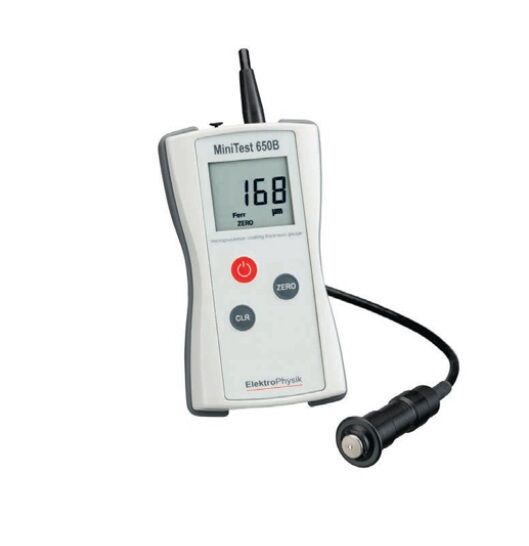
3040650 RUPAC Ferrous Layer Thickness Gauge, Minitest 650B-F Digitronic model, measuring range 0 ÷ 3000 μm, minimum base thickness 0.70 mm

3040650 RUPAC Ferrous Layer Thickness Gauge, Minitest 650B-F Digitronic model, measuring range 0 ÷ 3000 μm, minimum base thickness 0.70 mm

In stock
SKU
RP-3040650
Special Price €1,028.20 Regular Price €1,060.00
(Incl. Tax: €1,254.40)

This model represents the simplest and most practical solution for detecting coating thicknesses such as zinc, chrome, paint, anodizing, etc. The detection probe has been reduced in size to facilitate control even in small areas and is immovably connected to the control console. The latter features a large LCD display that provides measurement information to the operator. Supplied with a case, calibration set, and batteries.

  • Measuring Range: 0 ÷ 3000 μm
  • Accuracy: ± 3% of the measurement + 2 μm
  • Resolution: 1 μm
  • Minimum Base Thickness: 0.70 mm
  • Minimum Radius of Piece: 5 mm convex, 25 mm concave
  • Calibration Type: Zero calibration
  • Minimum Measuring Area: Ø 20 mm
  • Reading: on 11 mm LCD display
  • Unit of Measure: mm / inch
  • Power Supply: 1.5 V AAA batteries (3 pcs.)
  • Dimensions: 70 x 122 x 22 mm / Probe Ø 15 x 62 mm
  • Weight: 225 g

A thickness gauge for ferrous layers is a tool used to measure the thickness of coatings or coverings applied to ferrous metal surfaces. These devices are essential in various industrial sectors to ensure the quality, safety, and compliance of products. Here is a detailed explanation of their use and importance:

What is a thickness gauge for ferrous layers used for?

Quality Control

  • Uniformity of Coating: Ensures that the coating is applied uniformly over the entire surface, avoiding areas with insufficient or excessive thickness.
  • Compliance with Specifications: Verifies that the coating thickness meets the technical specifications required for the finished product, ensuring it meets quality standards.

Corrosion Protection Measurement

  • Protection of Metal Surfaces: Measuring the thickness of anti-corrosion coatings, such as paints, enamels, or galvanic coatings, is fundamental to preventing corrosion of ferrous metal surfaces.
  • Product Longevity: Adequate coating extends the product's useful life, reducing maintenance and replacement costs.

Safety Verification

  • Structural Safety: In the construction and civil engineering sectors, ensuring that protective coatings are sufficiently thick is crucial to maintaining the structural integrity of buildings.
  • Failure Prevention: In critical applications, such as the aerospace and automotive industries, thickness gauges ensure that components are properly coated to prevent catastrophic failures.

Process Efficiency

  • Optimization of the Coating Process: Helps optimize the coating application process, reducing material waste and improving production efficiency.
  • Cost Reduction: Accurate control of coating thickness can reduce costs associated with excessive use of coating materials.

How does a thickness gauge for ferrous layers work?

These instruments use various measurement principles, including:

  • Magnetic: Measures the variation in the magnetic field generated by the presence of the coating on a ferrous substrate.
  • Eddy Currents: Uses induced currents to determine the thickness of non-conductive coatings on ferrous and non-ferrous substrates.
  • Ultrasound: Employs sound waves to measure the thickness of the coating and the metal base.

Practical Applications

Thickness gauges for ferrous layers are used in various sectors, including:

  • Automotive Industry: Control of paint and protective coatings on vehicles.
  • Shipbuilding: Verification of anti-corrosion coatings on ships and boats.
  • Industrial Plants: Control of coatings on pipes, tanks, and metal structures.
  • Construction: Measurement of protective coatings on steel and iron structures.

In conclusion, thickness gauges for ferrous layers are indispensable tools for ensuring the quality, safety, and durability of metal products. They play a crucial role in the quality control of coatings, protecting ferrous surfaces from corrosion and improving the efficiency of production processes.

Brand:
RUPAC
Typology:
Layer thickness gauges