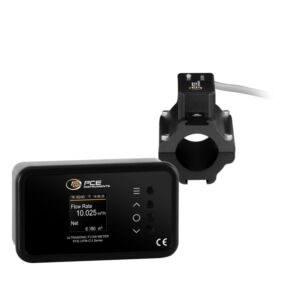
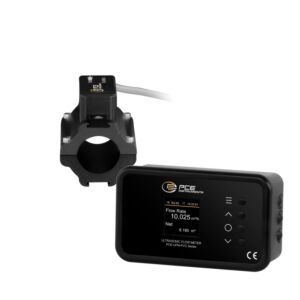
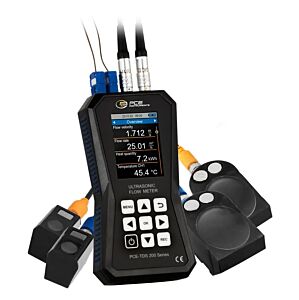
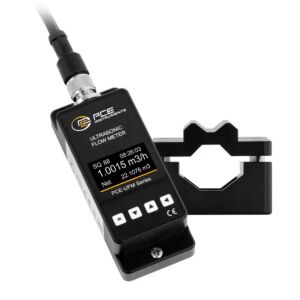
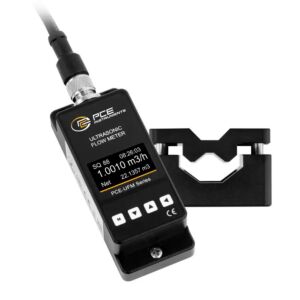
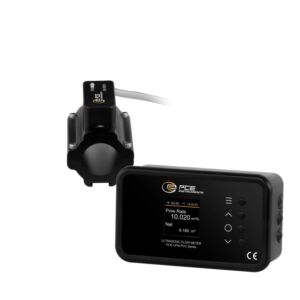
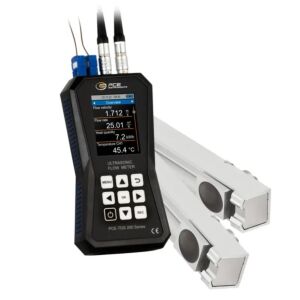
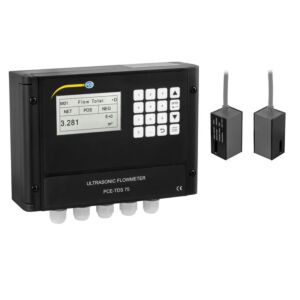
The Flow Meters category includes professional instruments designed to measure flow rate, flow velocity and fluid volume passing through pipes, technical circuits, industrial systems, HVAC installations, hydraulic networks, cooling circuits, process lines, test benches, distribution systems and energy monitoring applications. A flow meter converts fluid movement into measurable technical data, useful for verifying system operation, checking pump performance, detecting flow drops, analysing efficiency losses, balancing circuits and documenting real operating conditions.
Professional flow meters can use different measurement technologies depending on fluid type, pipe diameter, flow range, required accuracy and whether direct intervention on the system is possible. The image highlights ultrasonic instruments, often called clamp-on flow meters, equipped with external sensors applied to the pipe. This technology allows flow to be measured without interrupting the circuit, cutting the pipe or inserting parts directly into the fluid. It is a highly practical solution for industrial maintenance, plant commissioning, HVAC verification and checking existing systems, because it reduces intervention time and limits the risk of contamination or fluid loss.
The flow meter is used by applying the sensors to the pipe according to the configuration required by the instrument and entering the main pipe and fluid parameters, such as outer diameter, wall thickness, pipe material, fluid type, temperature and installation mode. In ultrasonic models, the instrument calculates flow velocity through the difference in signal propagation through the fluid and converts the value into volumetric flow rate. Correct parameter setting is essential, because an incorrect diameter, wall thickness, sensor distance or unsuitable pipe surface can lead to unreliable readings.
In industrial environments, flow meters are used to check cooling systems, water circuits, heat transfer fluids, heating systems, air-conditioning systems, pumps, heat exchangers, chillers, process lines, washing circuits, distribution networks and systems where flow rate directly affects performance, safety, quality and energy consumption. Insufficient flow can cause overheating, poor heat exchange, process instability, machine alarms, reduced productivity or component damage. Excessive flow can generate high energy consumption, vibration, noise, internal erosion, pressure losses and unnecessary stress on the system.
In HVAC applications, flow meters are especially useful for checking heating, cooling, air-conditioning, technical water circuits and hydraulic balancing. In models designed for thermal energy measurement, the instrument can combine flow rate with the temperature difference between supply and return lines, allowing the thermal power transferred by the system to be evaluated. This type of measurement is important for technicians, maintenance specialists and engineers who need to optimise consumption, verify performance, check heat exchangers, analyse unbalanced systems or document energy efficiency work.
The choice of a flow meter must consider measuring range, pipe diameter, pipe material, fluid type, temperature, pressure, accuracy, resolution, measuring technology, installation mode, display type, data memory, PC connection, Ethernet, cloud or supervisory system interface. Accuracy indicates how close the measured value is to the real flow rate, while resolution indicates the smallest variation that can be displayed or recorded by the instrument. For professional applications, both parameters must be evaluated, because an instrument can display very small variations but still require correct installation to provide truly reliable results.
In ultrasonic flow meters, installation quality is decisive. Sensors should be positioned on a straight section of pipe, preferably away from bends, valves, pumps, reductions, expansions, fittings or turbulence that can alter the flow profile. The pipe surface must be clean, regular and suitable for sensor contact. It is important to correctly use the gel or acoustic coupling material, respect the distance indicated by the instrument and verify signal quality. With very thick pipe walls, special materials, internal deposits, air bubbles or non-homogeneous fluids, measurement may require greater attention and more accurate configuration.
A flow meter is highly useful in preventive maintenance because it allows periodic checks to confirm whether system flow remains stable over time. A progressive decrease in flow may indicate clogged filters, scaling, deposits, partially closed valves, worn pumps, undersized pipes, air in the circuit or incorrect adjustments. A sudden variation may indicate a leak, blockage, valve failure, control problem or unexpected circuit change. Recording and comparing values allows targeted maintenance to be scheduled and plant downtime to be reduced.
In corrective maintenance, the flow meter helps quickly identify the cause of an existing problem. If a machine overheats, a circuit does not cool correctly, a heat exchanger underperforms, a pump works outside its operating point or an HVAC system does not deliver the expected performance, flow measurement helps distinguish a hydraulic issue from a thermal, electrical, mechanical or adjustment problem. In many cases, pressure alone is not enough, because a circuit may show apparently correct pressure but insufficient flow. For this reason, flow measurement complements pressure gauges, thermometers, data loggers and plant diagnostic instruments.
The connection between flow, adjustments, transmission backlash, heights, form errors and geometry is indirect but very important in industrial systems. In machine tools, cooling systems, coolant circuits, hydraulic systems and test benches, fluid flow can influence temperature, mechanical stability, thermal expansion, guideways, spindles, actuators, supports and moving components. Insufficient coolant flow can generate local temperature increases, dimensional variations, unstable reference heights, geometric errors, poor surface finish and reduced tool life. In hydraulic circuits, incorrect flow can change actuation speed, stroke repeatability, positioning, forces and functional behaviour of the system.
In test benches and technical laboratories, flow meters are used to verify the performance of pumps, valves, heat exchangers, filters, hydraulic components and complete systems. Measuring flow rate and flow velocity allows components to be compared, operating curves to be checked, pressure losses to be evaluated and system behaviour under real conditions to be documented. When the instrument includes data memory, digital interface or cloud connection, the technician can archive measurements, analyse trends over time and create useful documentation for quality control, testing and maintenance.
An important practical recommendation is not to consider flow as an isolated value. To correctly interpret a measurement, it is useful to compare it with pressure, temperature, pipe diameter, fluid viscosity, valve position, filter condition, pump speed and operating conditions. Low flow may have very different causes, such as a clogged filter, worn pump, unbalanced circuit or incorrectly adjusted valve. High flow may seem positive, but in some systems it can indicate incorrect settings, excessive energy consumption or lack of balancing.
For professional use, the measurement objective should be defined first. If the purpose is to check a pump, the measuring point should represent the real working circuit. If a heat exchanger is being checked, it is useful to measure flow and temperature on supply and return lines. If the goal is to identify a loss of efficiency in a system, it may be necessary to measure at several points and compare different sections of the circuit. With clamp-on flow meters, measurement repeatability also depends on being able to reinstall the sensors at the same point and with the same configuration.
Tadaah presents the Flow Meters category as a technical reference for companies, technicians, engineers, maintenance specialists, laboratories and quality departments that need to measure flow professionally, reliably and in a documentable way. Choosing the correct instrument helps verify systems, optimise consumption, control HVAC installations, diagnose anomalies, improve preventive and corrective maintenance, reduce inefficiencies and support technical decisions based on real data. To select the most suitable product, it is advisable to evaluate measurement technology, flow range, pipe diameter, fluid type, accuracy, resolution, installation method, data memory, available interfaces and operating environment.