PCE Instruments PCE-ACA 50 Test bench for plastics, rotating heating chamber, 10 ceramic crucibles included, measuring range from 5 to 1000°C
(Incl. Tax: €4,721.64)
PCE-ACA 50 test bench for determining ash content in plastics, composites and polymer materials according to ISO 3451 and GB/T 9345.1-2008. Features rotating cylindrical heating chamber Ø60 x 160 mm, automatic programmable temperature control from 5 to 1000 °C, 0.01 °C resolution, ±5 °C accuracy, 8 inch capacitive touchscreen, type K sensor, 220 V AC power supply, 10 ceramic crucibles, tweezers, crucible holder and fuses included.




The PCE-ACA 50 test bench is a professional laboratory instrument designed to determine ash content in plastics, plastic composites and polymer materials. It is mainly used to evaluate the amount of inorganic residue remaining after combustion and subsequent annealing of the sample. This parameter is essential in plastics quality control, recycled material verification, polymer research and production processes where the presence of fillers, impurities or unwanted materials must be measured accurately.
Ash content is expressed as mass or mass fraction after thermal treatment of the sample. During the test, the plastic material is exposed to high temperatures inside the heating chamber, burning the organic component and leaving mineral or inorganic non-combustible substances as residue. The subsequent annealing ensures that combustion residues are completely converted into stable ash that cannot be further burned.
The PCE-ACA 50 is suitable for determining ash content in plastics such as polyethylene, polypropylene and polybutene, as well as technical plastics, compounds, filled materials and samples from recycling processes. In production, excessive ash content may indicate contaminants, unexpected fillers, mineral residues, impurities introduced during processing or variations in material formulation. In recycling, ash content measurement helps evaluate the purity of recovered material and its suitability for further use.
The instrument supports tests according to ISO 3451 and GB/T 9345.1-2008 standards, making it suitable for laboratories that must work with traceable and comparable procedures. Compliance with standardized methods is important when results are used for internal certification, customer-supplier checks, technical documentation, production batch verification or material qualification.
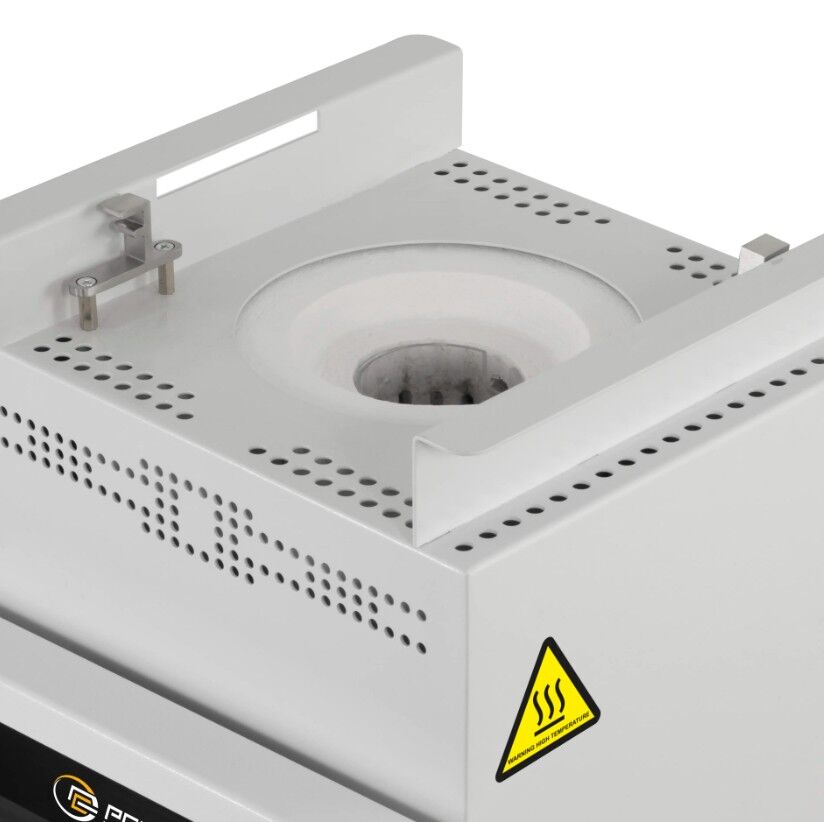
The rotating cylindrical heating chamber is an important technical feature of the test bench. Rotation and cylindrical geometry promote more uniform temperature distribution, helping to obtain more homogeneous thermal treatment of the sample. Well-distributed temperature improves test reliability and reduces the risk of results altered by colder or hotter areas inside the chamber.
The instrument temperature range is 5 ... 1000 °C, with 0.01 °C resolution and ±5 °C accuracy. This range allows thermal cycles suitable for combustion and annealing of different plastic materials to be set. Programmable temperature control allows the process to be adapted to specific test requirements, material type and laboratory procedure. The type K temperature sensor contributes to controlling the thermal process during analysis.
Automatic temperature control allows the heating cycle to be managed more steadily. In ash content analysis, temperature stability is essential because uncontrolled variations can affect combustion completion, residue conversion and result repeatability. The instrument also displays heating time, giving the operator continuous monitoring of the complete test process.
The 8 inch capacitive touchscreen makes the test bench intuitive and practical to use. The interface allows the main functions to be set and controlled, the heating cycle to be followed and process information to be viewed directly from the front panel. For a laboratory performing repeated analyses, a clear interface reduces the risk of operating errors and improves daily test management.
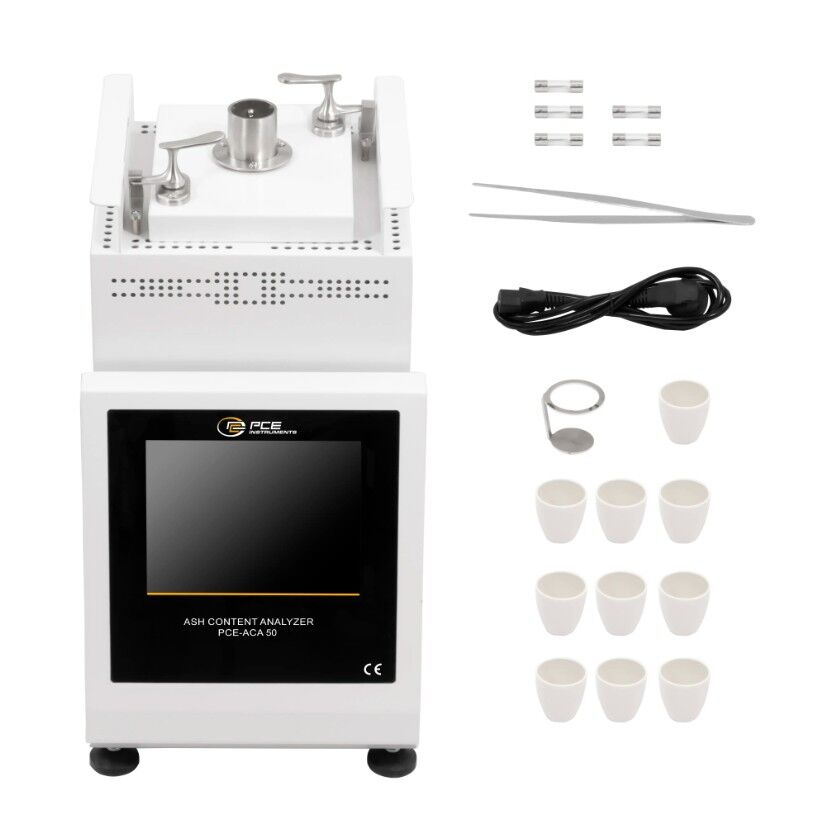
The heating chamber measures Ø60 x 160 mm and is designed to accommodate the supplied ceramic crucibles. The scope of delivery includes 10 crucibles, allowing multiple samples or spare crucibles to be prepared for analysis. Ceramic crucibles are suitable for high temperatures and contain the sample during combustion and annealing. The included crucible holder and tweezers make accessory handling safer and more orderly.
Correct sample preparation is essential to obtain reliable results. The material must be accurately weighed before thermal treatment, placed in a clean crucible and handled according to the applicable test procedure. After combustion and annealing, the residue must be cooled and weighed again to determine residual mass. Balance quality, crucible cleanliness and thermal process stability directly influence the final result.
The IP20 protection rating indicates that the device is intended for controlled indoor environments such as laboratories, quality departments and protected technical areas. It is not designed for exposure to heavy dust, water, excessive humidity or dirty industrial environments. The specified operating and storage conditions are -20 ... 50 °C with 0 ... 50% relative humidity, values that should be respected to protect the electronics, touchscreen and control system.
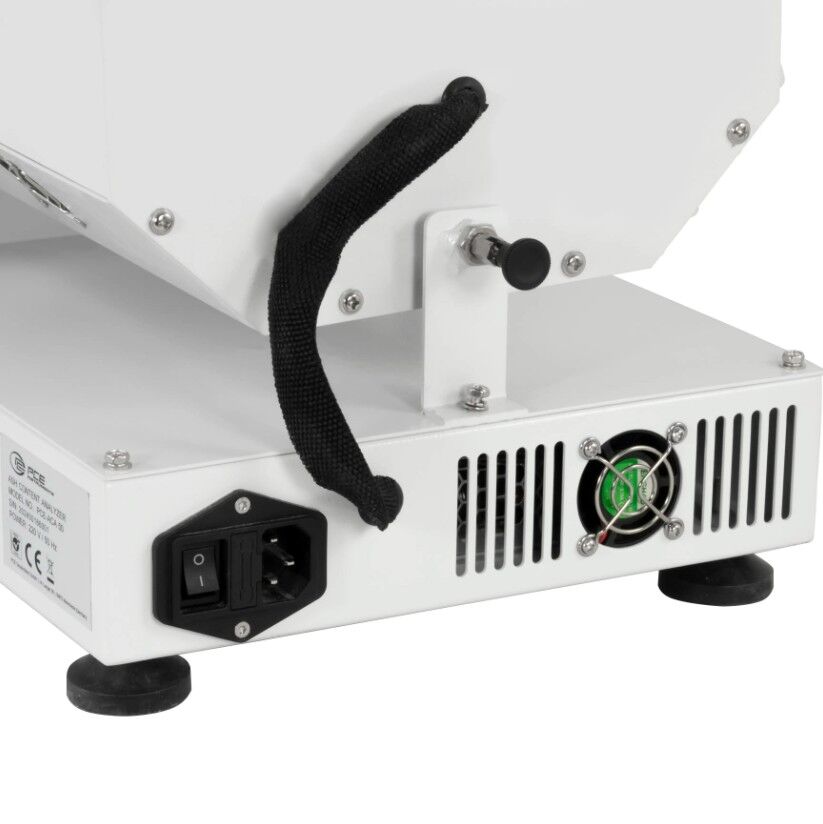
Power supply is 220 V AC 50 ... 60 Hz via grounded power socket. Grounding is important for electrical safety, especially considering the presence of high-temperature heating elements and control components. Before use, power compatibility, cable integrity, stable work surface and sufficient space around the test bench for heat dissipation and safe sample handling must be checked.
The overall dimensions are 380 x 260 x 500 mm and weight is 14.4 kg. These values indicate a compact bench-top instrument suitable for laboratories with limited space but requiring professional ash content analysis. The support feet allow stable positioning on the workbench, while the enclosed structure protects the chamber and components during testing.
The PCE-ACA 50 is particularly useful in plastics recycling processes. In this sector, ash content determination makes it possible to assess the presence of mineral contamination, non-polymeric residues, fillers and impurities that may influence the performance of recycled material. A material with non-compliant ash content may cause problems in processability, finished product quality, mechanical properties or compatibility with technical specifications.
In production, the test bench can be used to check batches of raw material, compounds, filled materials, intermediate products and finished samples. In research and development departments, it allows formulations to be compared, the effect of additives or mineral fillers to be verified and the stability of different materials to be evaluated. In universities and material testing centres, it is a useful instrument for teaching, experimental work and polymer characterization.
For correct use, the procedure required by the standard or the laboratory’s internal method must be carefully followed. It is important to use clean crucibles, avoid contamination, weigh samples with suitable instruments, respect heating times and temperatures, allow residues to cool in a controlled manner and accurately record data. Ash content determination is simple in principle, but it requires operating rigor to obtain reliable values.
During use, attention must be paid to the high temperatures reached by the heating chamber and crucibles. The operator must use suitable protective equipment, handle crucibles with the supplied tweezers or compatible tools, avoid contact with hot surfaces and place the test bench in a ventilated and suitable area. Management of fumes and residues must comply with laboratory procedures and the nature of the material being analysed.
The scope of delivery includes 1 PCE-ACA 50 test bench, 1 power cable, 10 ceramic crucibles, 1 tweezers, 1 crucible holder, 5 miniature 10 A fuses and operating instructions available for download. The equipment allows the test bench to be prepared for analysis and provides the main accessories for sample handling and routine maintenance.
The PCE-ACA 50 test bench is therefore a professional solution for laboratories and companies that need to determine ash content in plastics with programmable thermal control and a procedure compliant with standardized methods. The combination of temperature up to 1000 °C, 8 inch touchscreen, rotating cylindrical heating chamber, type K sensor, 10 included ceramic crucibles and compact bench-top structure makes it suitable for quality control, production, recycling, research and development and polymer material analysis.
PCE-ACA 50 Test Bench - Technical Specifications
| Parameter | Value |
|---|---|
| Temperature - Measuring range | 5 ... 1000 °C |
| Temperature - Resolution | 0,01 °C |
| Temperature - Accuracy | ±5 °C |
| Display type | Touch screen |
| Display size | 8 inches |
| Standard | GB/T9345-2008, ISO3451 |
| Sensor | Type K |
| Sensor dimensions | Heating chamber: Φ60 x 160 mm |
| Menu language | English (GB), English |
| Device protection class | IP20 |
| Power supply | 220 V AC | 50 ... 60 Hz |
| Connector type | Ground contact plug |
| Weight | 14,4 kg |
| Operating conditions | -20 ... 50 °C, 0 ... 50 % R.H. |
| Storage conditions | -20 ... 50 °C, 0 ... 50 % R.H. |
| Dimensions (L x W x H) | 380 x 260 x 500 mm |
PCE-ACA 50 Test Bench - Delivery Contents
| Quantity | Description |
|---|---|
| 1 x | PCE-ACA 50 test bench |
| 1 x | Power cable |
| 10 x | Ceramic crucible |
| 1 x | Tweezers |
| 1 x | Crucible holder |
| 5 x | Miniature fuse 10 A |
| 1 x | User manual available as download |
- EAN Code:
- 4250348735300
- Typology:
- Control bench centers
- Brand:
- PCE INSTRUMENTS
- Resolution (mm):
- 0.01 °C