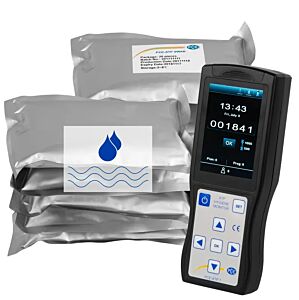
Luminometers are professional instruments designed for rapid surface hygiene control through the measurement of bioluminescence generated by the presence of ATP and AMP. ATP, adenosine triphosphate, is a molecule found in organic residues and living cells, while AMP, adenosine monophosphate, can be used in some analysis systems to increase detection sensitivity. When the sample collected from the surface comes into contact with the reagent contained in the swab or test tube, a light reaction is generated in proportion to the amount of biological residue detected. The luminometer measures this emission and returns a value expressed in RLU, Relative Light Units, allowing the operator to determine whether the checked surface is acceptable, requires attention or must be sanitized again.
This technology is especially useful because it provides results very quickly, often within a few seconds, without the long waiting times typical of traditional microbiological analysis. A luminometer does not replace all laboratory testing, but it is a highly effective operational tool for daily hygiene checks, verification after cleaning, monitoring of critical points and documented process control. In production or food-processing environments, knowing immediately whether a surface contains organic residues allows corrective action to be taken at once, reducing the risk of cross-contamination, non-conformity, production downtime or rework.
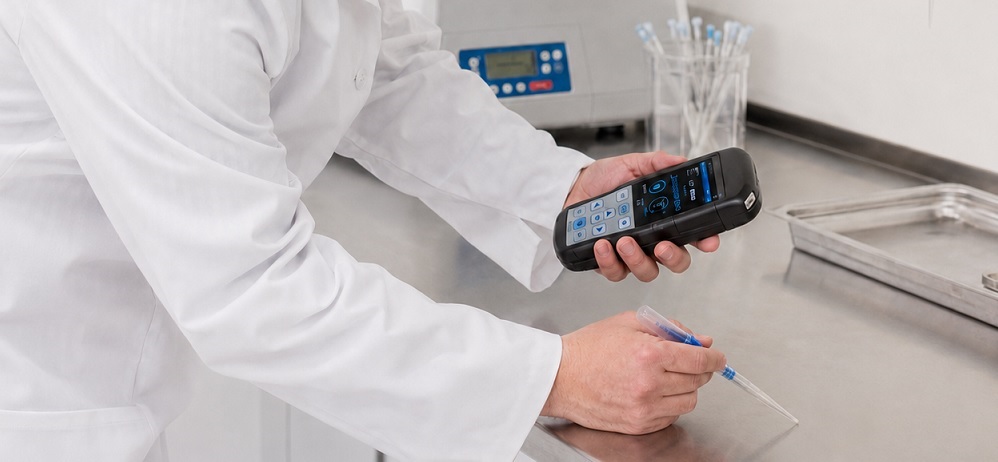
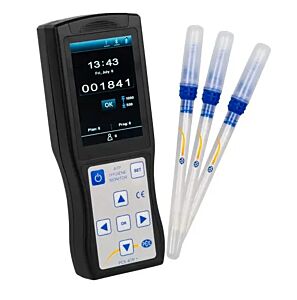
The operation of a luminometer is simple, but a correct procedure is essential to obtain reliable results. The operator uses a dedicated ATP swab, wipes it across the surface according to a defined sampling area, activates the reagent and inserts the swab into the instrument. After measurement, the display shows the RLU value and, in professional models, can also indicate the control status according to preset thresholds, such as pass, warning or fail. The possibility of storing results, associating date, time and measuring points, transferring data via USB or Bluetooth and managing historical measurements makes the luminometer suitable for traceability and control documentation.
In the food industry, luminometers are used to check work surfaces, conveyor belts, tools, containers, slicers, mixers, filling lines, packaging machines, tanks, tables, cold rooms and handling areas. In the pharmaceutical and cosmetic sectors, they are used to inspect environments, equipment, benches, components and surfaces involved in production or packaging. In healthcare, hospitality, schools, public facilities and professional cleaning services, these instruments make it possible to verify the effectiveness of sanitation procedures on high-contact surfaces such as handles, worktops, devices, trolleys, tools and operational areas. In all these applications, the main advantage is the transition from visual assessment to a quantitative and repeatable measurement.
The accuracy and resolution of a luminometer depend on the quality of the optical system, sensor sensitivity, reagent stability, correct sampling procedure and management of acceptance thresholds. The RLU value should not be interpreted as a direct count of bacteria, but as a quantitative indicator of organic material and potential residual contamination. For this reason, it is important to define operating thresholds that are consistent with the environment, the surface being tested, process risk and the company hygiene plan. A low value generally indicates a clean or correctly sanitized surface, while a high value suggests the possible presence of residues and requires further cleaning or additional checks.
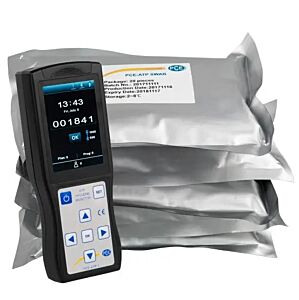
Measurement repeatability is essential. To obtain comparable results over time, operators must sample similar areas, use the same swabbing technique, respect reagent activation times, avoid accidental contamination and store swabs or test tubes correctly. The storage temperature of reagents can also influence measurement quality, so it is important to follow the manufacturer’s instructions and use consumables that are compatible with the instrument. In professional models, self-calibration helps maintain stable instrument response and reduces the risk of operator error, but it does not eliminate the need for a correct procedure and proper operator training.
Advanced luminometers include internal memory for thousands of measurements, USB and Bluetooth interfaces for data transfer, software for result analysis and functions for managing control points. These features are very important for companies that need to document HACCP checks, prepare reports for internal or external audits, verify cleaning effectiveness over time and demonstrate procedure compliance. Data recording helps identify recurring critical areas, operators requiring additional training, cleaning steps that need improvement and surfaces requiring greater attention. In this way, the luminometer is not only a measuring instrument but also a technical support tool for hygiene management.
From a practical point of view, the choice of a luminometer must consider the environment in which it will be used. In production, robustness, speed, ease of use, readable display, reliable battery and the possibility of working with gloves are important. In laboratories, sensitivity, repeatability, storage capacity and compatibility with analysis software are key factors. For cleaning companies and mobile inspections, portability, autonomy, easy transport, data management and rapid response are essential. In food or pharmaceutical departments, where checks are frequent and documented, instruments with large memory, control point identification and digital transfer of results are particularly useful.
Correct use also requires attention to surface geometry and the sampling point. Although this category does not involve heights and transmission backlash in the same way as machine tools, the technical concept can be applied to measuring position, surface accessibility and repeatability of the operator’s movement. Curved surfaces, grooves, joints, internal areas, edges, corners, handles and removable components can retain residues and must be sampled methodically. A shape or geometry error in the surface, such as a gap, irregular weld, non-smooth area or difficult-to-clean point, can affect the control result because it favors the accumulation of organic material. For this reason, the luminometer is also useful as an indirect tool for highlighting issues in hygienic design, maintenance or cleaning.
Instrument settings mainly concern acceptance thresholds, identification of measuring points, user management, result storage and data transfer. Depending on the company control plan, different limit values can be defined for direct product-contact surfaces, general work surfaces, non-contact areas, equipment, tools or environments. This makes it possible to adapt the control to the real process risk and make the measurement more useful for quality management. An RLU value must always be interpreted in the correct context: the same reading can have a different meaning on a food-contact worktop, on a technical floor or on the external surface of a machine.
In preventive and corrective maintenance, luminometers can be used to verify cleaning effectiveness after work on machines, systems, belts, tanks, pumps, valves or dismantled parts. After maintenance, residues of lubricants, organic material, technical dirt or contamination from handling may remain on surfaces. ATP control allows operators to quickly verify whether the area is suitable for restarting the process or whether additional sanitation is required. This is especially useful in the food, pharmaceutical and cosmetic industries, where maintenance must be integrated with documented hygiene and quality procedures.
Luminometers are therefore essential professional instruments for companies, technicians, engineers, maintenance teams and laboratories that need to control hygiene quickly, objectively and traceably. The ability to obtain immediate results, record thousands of measurements, transfer data digitally and set operating thresholds makes these instruments suitable for modern quality systems and controlled production processes. For Tadaah, a category dedicated to luminometers provides a complete technical reference to help customers select the correct device according to the type of control, application sector, frequency of use, traceability requirements and required level of precision.