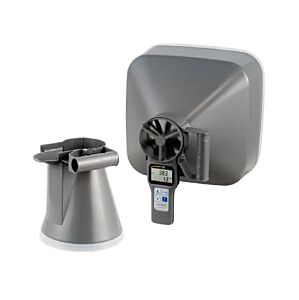
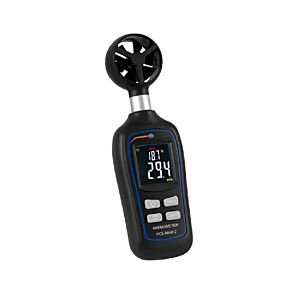
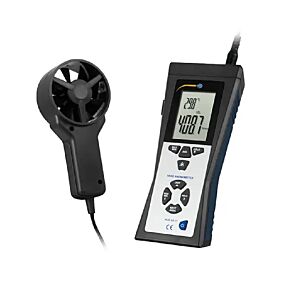
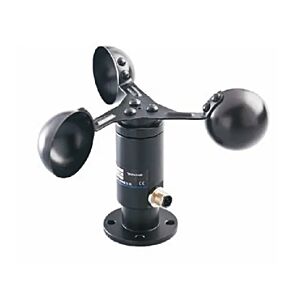
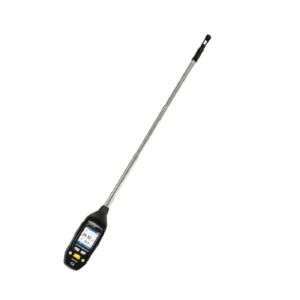
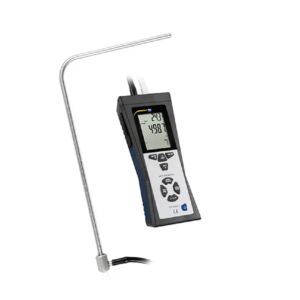
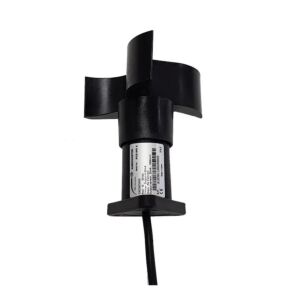
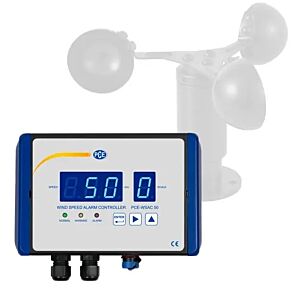
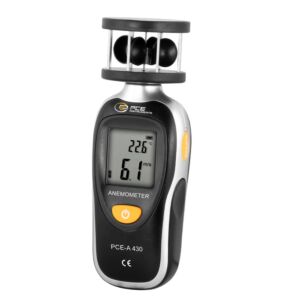
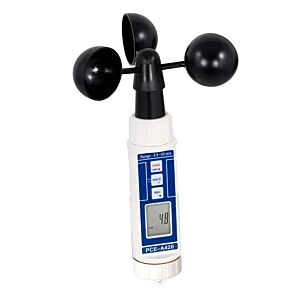
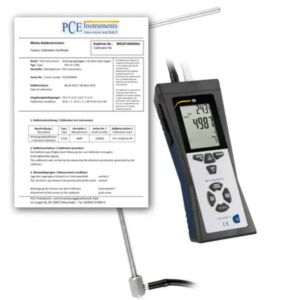
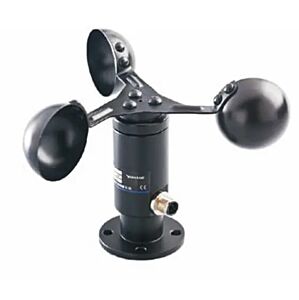
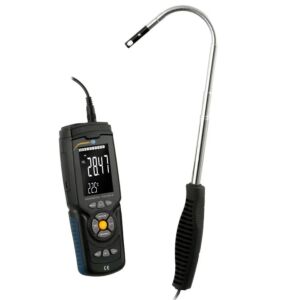
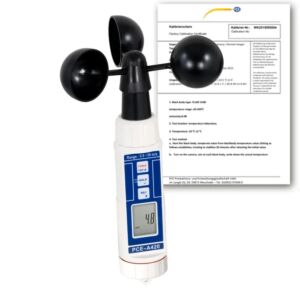
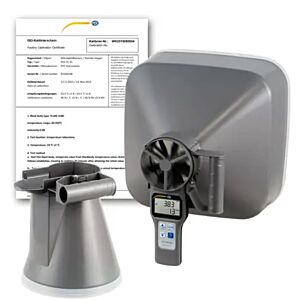
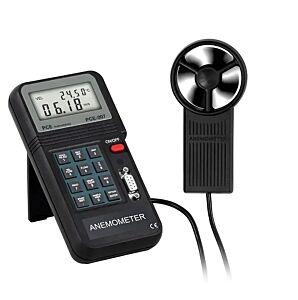
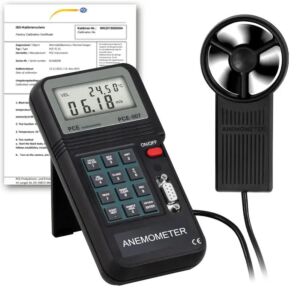
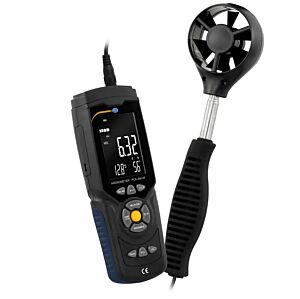
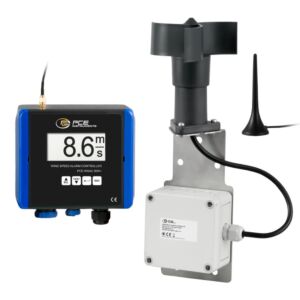
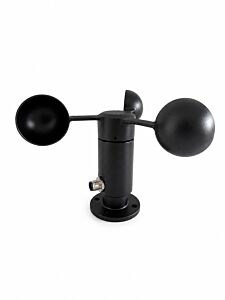
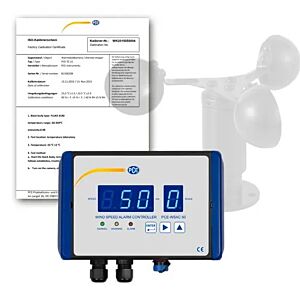
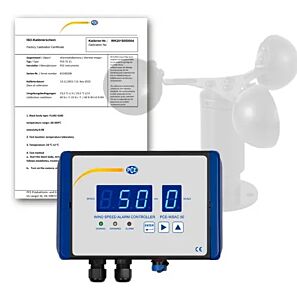
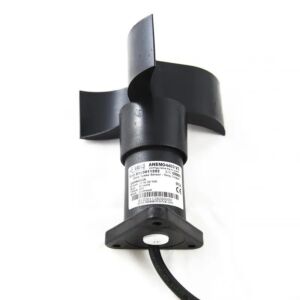
The Anemometers category includes professional instruments designed to measure air velocity, airflow, volumetric flow rate, wind direction and key parameters related to ventilation, microclimate and system control. An anemometer converts air movement into measurable technical data, useful for checking HVAC systems, fans, extractors, ducts, outlets, hoods, spray booths, climatic chambers, cooling systems, industrial environments and process systems where air movement affects safety, quality, efficiency and operating stability.
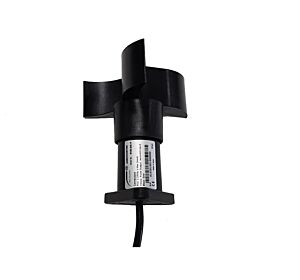
An anemometer can be used in different ways depending on instrument type and application. Vane anemometers are suitable for measuring air velocity and flow rate in ducts, outlets, grilles, ventilation openings and areas where the airflow is relatively defined. Cup anemometers are suitable for environmental measurements, outdoor wind, meteorological monitoring, exposed systems and applications where air velocity must be detected continuously and independently from the main flow direction. Models with telescopic or flexible probes make it possible to reach difficult points, deep ducts, narrow sections, grilles, channels, cavities, hoods and measuring points where the instrument body cannot be positioned directly. More complete instruments may include data memory, software, digital interfaces, data logger functions, flow calculation, temperature, humidity and ISO calibration certificate.
In industrial and technical applications, air velocity measurement is essential for verifying whether a system is operating as expected. Insufficient ventilation can cause overheating, accumulation of fumes, dust or vapours, poor cooling efficiency, problems in drying, painting, extraction or filtration processes. Excessive ventilation can generate energy loss, turbulence, noise, process instability, uneven drying, difficult thermal control and higher consumption. For this reason, an anemometer should not be considered only a wind measuring instrument, but a technical device for evaluating real air behaviour in a system.
In HVAC, anemometers are used to check airflow and air velocity in heating, ventilation and air-conditioning systems. The technician can verify supply outlets, return grilles, ducts, filters, fans, air handling units, local extraction systems and system balancing. Velocity measurement, combined with the section of the duct or outlet, allows volumetric flow rate to be calculated and confirms whether the distributed air matches the design or operating requirements. This is especially important in laboratories, production departments, technical rooms, warehouses, controlled environments and areas where air exchange and environmental stability directly affect work quality.
Anemometers are also very useful in preventive and corrective maintenance. A reduction in air velocity in a duct may indicate clogged filters, worn fans, obstructions, incorrectly adjusted dampers, dirty ducts, leaks, control changes or power supply problems. An abnormal increase may result from incorrect settings, reduced sections, imbalance between system branches or undocumented modifications. Comparing values over time helps identify progressive drift and schedule interventions before the problem becomes critical. In corrective maintenance, the anemometer helps quickly locate the cause of poor ventilation, an overheated area, an inefficient hood or an unbalanced system.
The choice of an anemometer must be based on measuring range, accuracy, resolution, sensor type, vane diameter, probe shape, response time, flow calculation capability, data memory, software, digital interface, robustness, power supply and operating environmental conditions. Accuracy indicates how close the measured value is to the real value, while resolution indicates the smallest variation that can be displayed or recorded. For professional use, the instrument should not be selected only according to price or maximum range, but according to the type of flow to be measured, measuring point geometry and documentation requirements.
To obtain reliable measurements, the anemometer must be used methodically. The probe must be positioned correctly in relation to the flow direction, avoiding excessive inclination that could distort the value. In ducts, it is advisable to take several measurements across the section and calculate an average, because airflow is not always uniform: it may be faster in the centre, slower near the walls and disturbed by bends, dampers, filters, grilles, reductions or fans. The measuring position should preferably be chosen on straight sections, away from turbulence and obstacles. On outlets and grilles, cones or specific accessories can improve flow-rate measurement.
Measuring height is an important parameter, especially in workplaces and microclimatic checks. Air velocity can vary between floor level, operator zone, machine level and the upper part of the environment. In a laboratory or production department, a local air current can influence comfort, thermal stability, material drying, sensitive instrument operation and precision of certain measurements. In spray booths, extraction hoods and controlled environments, air distribution must be uniform and consistent with the process, because turbulence or incorrect airflow may compromise the final result.
The connection between anemometry, temperature, geometry and mechanical stability is more important than it may seem. Air movement affects cooling, heat dissipation, heat accumulation and environmental uniformity. In machine tools, metrology laboratories and precision processes, thermal variations caused by non-uniform ventilation can generate expansion, height differences, instability of reference heights, dimensional errors, form and geometry errors. Direct airflow on a machine, workpiece or measuring instrument can change local temperature and therefore influence the technical result. For this reason, air velocity control is also useful in environments where dimensional measurements or precision machining are performed.
Regarding transmission backlash, anemometers do not directly measure mechanical play, couplings or geometric defects, but they can help identify conditions that indirectly affect them. Insufficient cooling on motors, gearboxes, spindles, electrical cabinets or machine ventilation systems may cause overheating, lubrication changes, thermal expansion and variation in functional clearances. Correct ventilation, on the other hand, helps maintain component temperature more stable and reduce thermal drift that can modify fits, adjustments and movement accuracy.
In laboratories and quality control, anemometers are used to verify environmental conditions, air exchange, hoods, climatic chambers, test benches, controlled flows and extraction systems. In production departments, they can be used to check local extraction, removal of dust, vapours, fumes, light chips or aerosols. In painting, drying and surface treatment processes, air velocity affects process uniformity, drying times, surface quality and safety. In cooling systems, airflow influences the temperature of motors, inverters, electrical cabinets, compressors, exchangers and electronic components.
Models with data logger, memory and software are particularly useful when an instantaneous measurement is not enough. In some systems, airflow changes during the cycle, at start-up, depending on load, with damper opening, fan speed variation or progressive filter clogging. Recording values makes it possible to identify peaks, drops, instability, oscillations and drift that would not be visible with a single reading. Data documentation is useful for commissioning, maintenance, internal audits, comparison between interventions and efficiency analysis.
An important practical recommendation is to always interpret air measurement together with other parameters. Velocity, flow rate, temperature, humidity, differential pressure, filter condition, damper position, fan speed and duct geometry must be considered together to understand real system behaviour. A velocity value that appears correct may not correspond to adequate flow if the section differs from the value entered or if the flow is turbulent. Similarly, correct flow rate may not guarantee good performance if air distribution is not uniform.
Tadaah presents the Anemometers category as a technical reference for companies, technicians, engineers, maintenance specialists, laboratories and quality departments that need to measure air velocity and flow professionally. Choosing the correct instrument makes it possible to check ventilation, HVAC systems, extraction systems, industrial processes, cooling, microclimate and real operating conditions. To select the most suitable product, it is advisable to evaluate sensor type, measuring range, accuracy, resolution, flow calculation, accessories, data logger, software, certification, robustness and operating environment.