

Introduction
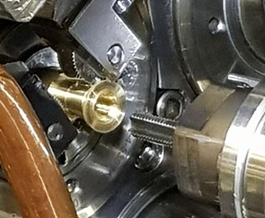
The machining of lead-free brass CW510 represents one of the most complex challenges in production on mechanical multi-spindle automatic lathes, especially in small turned parts manufacturing. Compared to traditional brass CW614, the material behaves differently in terms of chip formation, heat dissipation, and dimensional stability, making process control more difficult.
Production issues encountered
During production start-up, the customer encountered several critical issues that prevented the achievement of the required dimensional and production targets. In particular, problems were observed in chip control, dimensional variations during machining, and a significant reduction in machine efficiency.
The presence of improperly evacuated chip caused frequent tool breakages, while the high temperature generated during machining negatively affected dimensional stability.
Technical process analysis
The Tadaah technicians intervened directly in production, analyzing the working cycle, machine behavior, and component drawing with its tolerances. Scrap parts were also measured and analyzed in detail to identify the main causes of non-conformities.
To structure the analysis, the “fishbone” method (cause-and-effect diagram) was used, which allowed the identification of critical process factors, including:
- high temperature during machining
- poor chip evacuation
- dimensional instability during the cycle
Machine intervention and temporary optimization
In an initial phase, it was necessary to stabilize the production process to ensure continuity and avoid machine downtime. Therefore, direct machine adjustments were made, modifying machining parameters and tool sharpening.
Sharpening was performed directly in production using Tyrolit abrasive wheels, allowing rapid adaptation of the tools to operating conditions.
These interventions made it possible to achieve stable production for several consecutive days, temporarily improving chip management and dimensional stability.
Final process optimization
The analysis of operating conditions made it possible to define a series of structural interventions aimed at ensuring long-term process reliability. In particular, the following actions were implemented:
- design of new tools specifically for CW510 material
- development of new cams optimized for the working cycle
- complete revision of the machining cycle
- training of personnel for correct tool sharpening
Results achieved
The implemented interventions led to a significant improvement in production performance. The machining process became stable, with correct chip evacuation and no production cycle interruptions.
Cycle time was reduced to levels comparable to standard brass CW614 machining, while maintaining the required tolerances. Tool life, although lower compared to CW614, remained at optimal levels and compatible with continuous industrial multi-shift production.
Conclusion
The machining of lead-free brass CW510 requires a structured technical approach and a deep understanding of the production process. Root cause analysis, combined with targeted interventions on tools, parameters, and the machining cycle, makes it possible to achieve a stable, efficient process compliant with the required dimensional specifications.




Comments