

Introduction
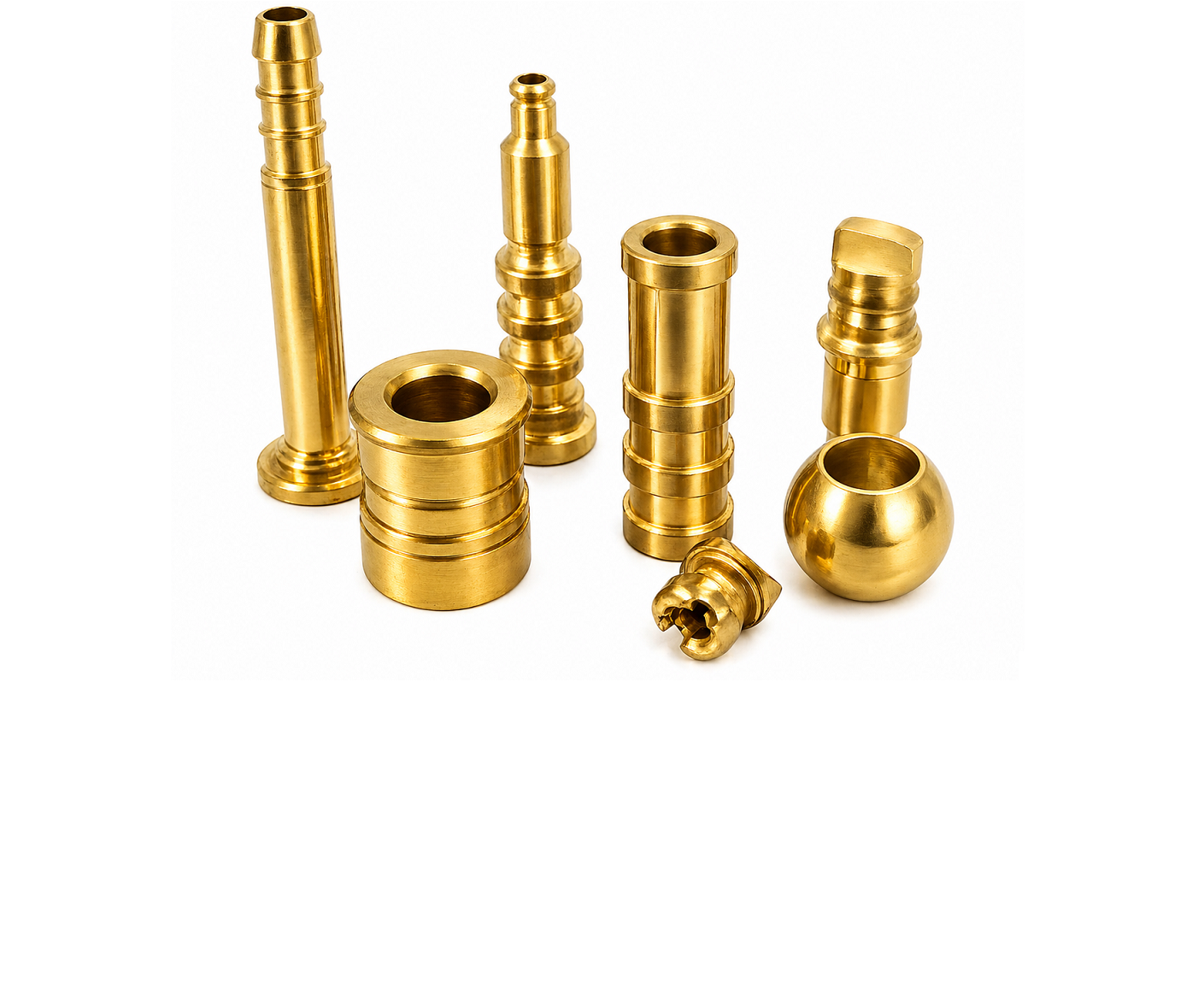
The machining of lead-free brass CW510, compared to traditional brass CW614, introduces significant variations in material behavior during turning on multi-spindle automatic lathes. Although the two alloys may appear similar, differences in chip formation, heat development, and dimensional stability require a completely different process management approach.
CW614 machining
CW614 brass is one of the most stable and easily machinable materials in turned small parts production. During machining, chips are generally short and easily evacuated, helping to maintain stable operating conditions.
Dimensional stability is high, and the production process is generally easy to manage, with low sensitivity to variations in operating conditions. Even complex operations, such as threading or polygonal machining, can be performed easily without significant issues.
CW510 machining
The machining of CW510 brass presents specific critical issues that directly affect process stability. The main aspects include:
- higher heat generation during machining
- long and difficult-to-evacuate chip formation
- dimensional variations during the cycle
- higher frequency of tool sharpening
- sensitivity to bar deflection during machining operations
These factors make the process more unstable compared to CW614, requiring continuous monitoring of operating conditions.
Production process management
In the case of CW614 brass, production management is generally simple and stable. Tool interventions are mainly carried out based on wear, without the need for continuous process monitoring.
In contrast, CW510 machining requires a more structured approach. Chip control and temperature management become key elements to maintain dimensional stability and ensure production continuity.
In this context, machining parameters play a crucial role. Even small variations in operating conditions can significantly influence chip formation, temperature, and material behavior during machining. For this reason, stable and consistent working conditions must be defined and maintained throughout the production cycle.
At the same time, the following are essential:
- correct selection of tool geometry
- selection of the most suitable tool material
- effective management of the cooling system
The integration of dedicated solutions, such as cams designed to optimize machine kinematics, improves chip control and production continuity.
Influence of personnel on the process
CW510 brass machining requires a high level of technical expertise from the personnel involved.
The engineering department must be able to analyze the part drawing and define an appropriate manufacturing plan, selecting tools and operating strategies consistent with the material. Quality control plays a key role in the initial monitoring of production, allowing early detection of any deviations.
The machine operator must ensure correct management of the cooling system, timely tool replacement and sharpening, and the maintenance of stable operating conditions, contributing to process continuity and reliability.
Conclusion
The differences between CW510 and CW614 brass do not only concern the material itself, but the entire machining approach. While CW614 allows for a simple and stable process, CW510 requires precise control of all operating parameters, proper chip management, and machining cycle optimization.
In this context, the choice of the correct cutting fluid also plays a fundamental role. A suitable coolant improves heat dissipation, supports chip formation and evacuation, and contributes to dimensional stability during machining.
Only through an integrated technical approach—covering tools, machining parameters, machine kinematics, clamping systems, and coolant management—is it possible to achieve a stable, efficient production process that complies with dimensional specifications.





Comments