BORLETTI Portable compression dynamometers with from 10 gr to 250gr division and measuring range from 0,1÷1 Kg to 3÷30 Kg
(Incl. Tax: €303.49)
The BORLETTI portable compression dynamometer is an essential measuring instrument for determining the force exerted on an object. Ideal for industrial, scientific and quality control applications, it accurately measures compressive forces up to specific capacities. Compact and robust, it is perfect for use in the field or laboratory, guaranteeing reliable and easy-to-read results thanks to precise divisions.
Images shown is indicative and not proportional.

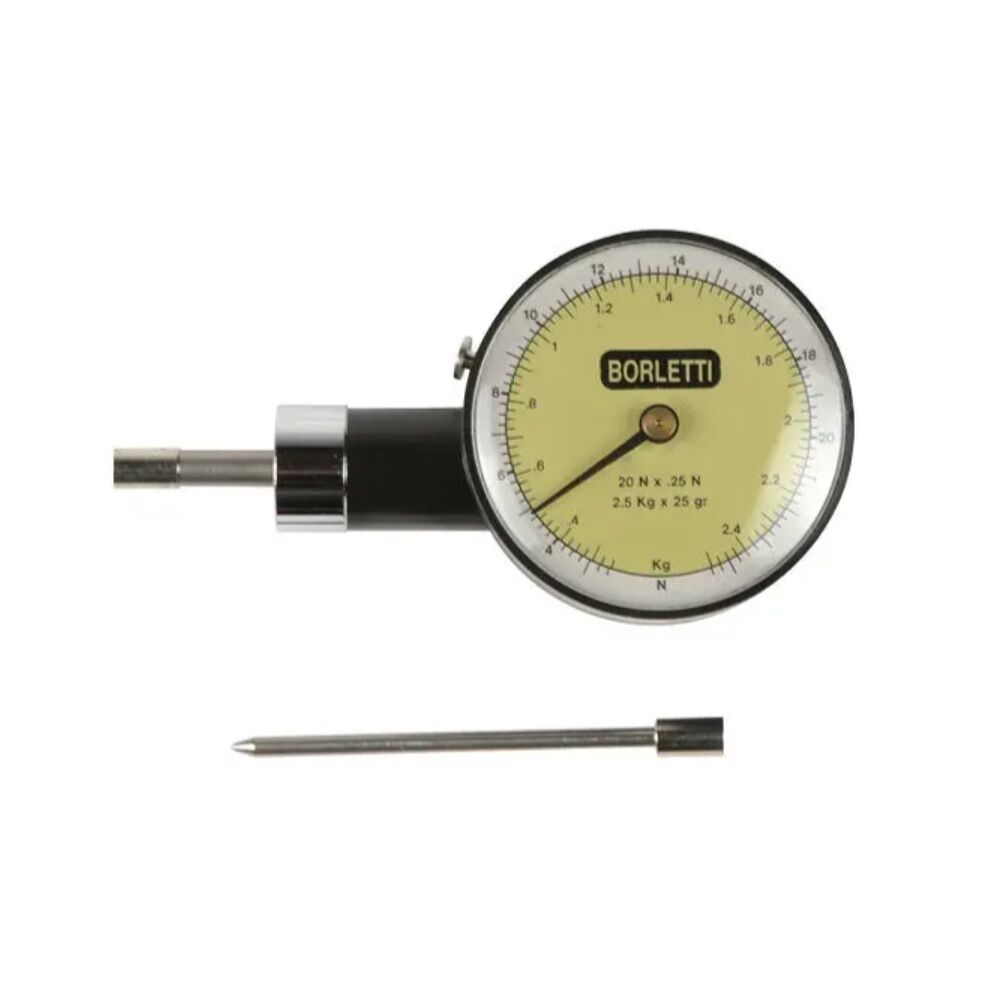
The Borletti portable compression dynamometer is a mechanical measuring instrument designed to detect and check the force applied in compression on a component, machine element or contact point. The image shows a compact structure with cylindrical body, thrust rod, interchangeable contact tip and analogue dial indicator, making it suitable for direct use in workshops, inspection departments and maintenance operations on machine tools and mechanical assemblies.
This type of dynamometer is used whenever an axial compression force must be measured quickly and directly. It is suitable for checking the reaction of springs, levers, stops, mechanical end positions, clamping devices, small mechanisms, elastic elements, friction units, microswitches, guides, assembled parts and preloaded systems. The operator places the contact tip on the point to be checked and gradually applies pressure; the dial allows the force value to be read directly, making the instrument practical for functional checks and field adjustments.
In the machine tool sector, a compression dynamometer is useful for checking contact thrust, end-stop settings, mechanical resistance, elastic return, support pressure and the operating condition of loaded components. It can be used during assembly, disassembly, preventive maintenance, mechanical overhaul and quality control on manufactured or assembled parts. The immediate analogue reading is useful for quick interventions where the technician needs to confirm whether an adjustment is within the required range or whether an abnormal condition is present.
Measuring compression force is also important when evaluating transmission play, abnormal friction, resistance to movement, elastic deformation, assembly errors and behavioural differences between similar components. In many applications, checking a geometric dimension or a linear height is not enough, because the correct function of a part also depends on the force with which it contacts, slides, compresses, returns or maintains its position. The dynamometer therefore complements dimensional inspection with a functional force check.
The analogue dial provides direct and intuitive reading, particularly useful during manual checks and progressive adjustments. The operator can observe the increase in force during compression and identify sudden variations, sticking points, yielding, irregular return or differences between several parts. This is valuable in quality control and maintenance, because it allows both the final force value and the mechanical behaviour during loading to be evaluated.
For correct use, the dynamometer should be kept aligned with the axis of the force being measured, avoiding inclined pressure that could cause reading errors or lateral stress on the rod. The contact tip must rest firmly on the surface to be checked and the force should be applied gradually, without shocks or overloads. Before measuring, it is advisable to check that the pointer is correctly positioned, the tip is securely fitted and the measuring range of the instrument is suitable for the expected force.
In industrial applications, this dynamometer is suitable for companies operating in precision mechanics, automotive, toolmaking, machine tool maintenance, mechanical assembly and quality control of functional components. It can be used to check return springs, locking systems, thrust devices, stop elements, mechanical controls, adjustment units, tight-tolerance components and parts subject to direct mechanical interaction.
The accuracy of the instrument depends on the correct measuring range, scale resolution, condition of the contact tip and method used to apply the force. To obtain repeatable results, it is important to use the same contact position, the same thrust direction and the same operating procedure. In repetitive checks on production batches, mechanical references, fixtures or dedicated supports can improve measurement consistency and reduce operator influence.
The Borletti portable compression dynamometer is therefore a simple but highly useful instrument for technicians, inspectors and maintenance operators who need to measure, compare or adjust mechanical forces quickly and reliably. Its compact shape, analogue reading and ability to work directly on the component make it suitable for both bench use and on-machine applications, providing effective support in diagnosis, adjustment and functional inspection operations.
DT Dynamometers technical table
| ART. | Capacity kg | Capacity N | Divisions gr | Divisions N |
|---|---|---|---|---|
| DT101 | 0,1÷1 | (0,98÷9,8) | 10 | (0,098) |
| DT102 | 0,25÷2,5 | (2,45÷24,5) | 25 | (0,24) |
| DT105 | 0,5÷5 | (4,9÷49) | 50 | (0,49) |
| DT110 | 1÷10 | (9,8÷98) | 100 | (0,98) |
| DT120 | 2÷20 | (19,6÷196) | 200 | (1,96) |
| DT130 | 3÷30 | (29,4÷294) | 250 | (2,45) |
- Brand:
- BORLETTI
- Typology:
- Dynamometer