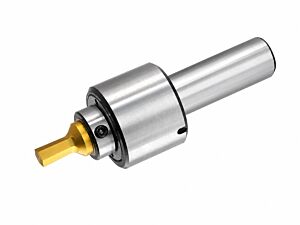
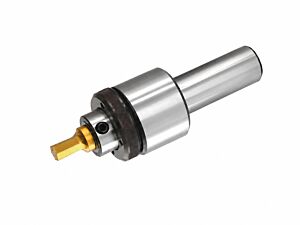
175.800 Fixed revolving broach toolholders for internal broaching, broach length 40 mm, cylindrical shank of your choice
(Incl. Tax: €303.05)
The fixed revolving broach toolholders for internal broaching with cylindrical shank are designed to produce regular internal profiles on lathes, machining centers and drilling machines using dedicated broaches with the correct H dimension. Machine rotation and axial feed allow internal hexagons, squares, slots, grooves and shaped profiles to be produced in through or blind holes. With H 40 mm, D 58 mm and cylindrical shanks from 20 to 40 mm, they are suitable for precision internal machining on larger profiles where centering, machine rigidity, correct pre-hole preparation and tool life are essential.


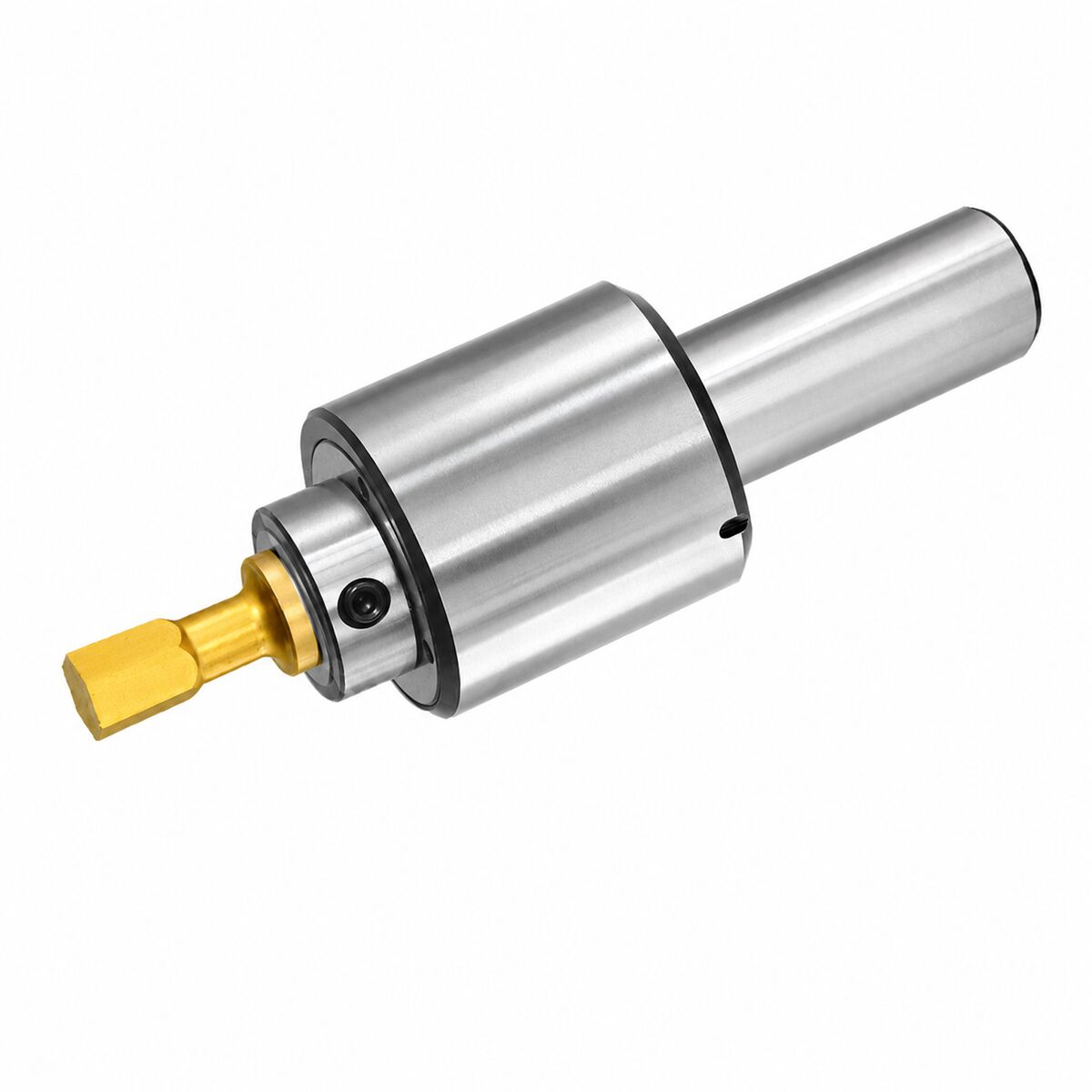
The fixed revolving broach toolholders for internal broaching with cylindrical shank are broach-holding devices designed to produce regular internal profiles on lathes, machining centers and drilling machines using dedicated broaches with the correct H dimension. They are suitable for producing internal profiles in through holes and blind holes, such as internal hexagons, internal squares, slots, grooves, shaped profiles and internal geometries generated by a specific broach. This version, with H 40 mm, D 58 mm and F 16 mm, is suitable for more demanding operations and larger internal profiles where high rigidity, correct centering and dimensionally compatible broaches are required.
The operating principle is based on rotary broaching. The broach is mounted in the toolholder with a slight controlled inclination relative to the axis of the broach holder body. This geometry allows the tool to progressively enter the material, removing the required section without engaging the entire profile at the same time. The rotation and axial feed supplied by the machine tool transfer the front shape of the broach into the hole, producing a regular, accurate and repeatable internal profile.
The operating principle remains the same even when the type of machine changes. On a lathe, the workpiece and the broach normally rotate while the broach holder body remains stationary. On a machining center, the workpiece and broach may remain stationary while the broach holder body rotates. On drilling machines or similar equipment, use is possible when sufficient rigidity, controlled feed and correct centering between spindle, broach and hole are ensured. In every configuration, final quality depends on the stability of the entire machine-toolholder-workpiece system.
These toolholders must be used with broaches having the H dimension specified in the table. The H dimension is essential because it defines the correct coupling between broach and toolholder. Using a non-compatible broach may alter the working inclination, increase friction, overload the bearings, cause tool seizure or produce out-of-size profiles. Before use, compatibility between broach, cylindrical shank, machine and required profile should always be checked.
Correct internal broaching requires a suitable pre-hole. The initial hole must be selected according to the profile to be produced, the material and the amount of stock to be removed. A pre-hole that is too small increases feed force, overloads the broach and may cause premature wear or tool seizure. A correctly dimensioned pre-hole reduces cutting resistance, improves finish and allows the broach to generate the profile more regularly. This is even more important on large profiles, tough materials or blind holes.
Centering is one of the decisive factors in rotary broaching. The broach must work as closely as possible on axis with the hole and the workpiece. Misalignment may generate eccentric profiles, out-of-size slots, irregular finish, premature wear of the broach and bearings, or a helical broaching effect. Before machining, it is advisable to check machine concentricity, workpiece clamping quality, absence of play in the toolholder and correct broach position relative to the hole.
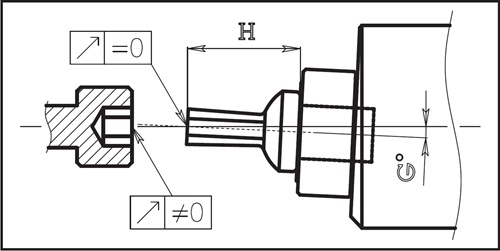
The feed rate must be selected according to material, stock removal section, profile size, machine rigidity and clamping stability. Spindle speed is important, but feed has a more direct effect on the load applied to the broach. Softer materials such as aluminum and brass allow smoother cutting conditions, while steel, cast iron and tougher materials require reduced load, better pre-hole preparation and suitable lubrication.
The initial contact phase between broach and workpiece is critical. At the beginning, the tool may tend to rub on the material before fully engaging. When the machine cycle allows it, a progressive entry should be used to help the tool reach full cutting contact quickly and avoid prolonged rubbing. After the initial working section, parameters can be stabilized according to depth and material. This helps reduce localized wear and improve internal profile quality.
Broaches used with these toolholders must be selected according to profile, material and required depth. Cutting edges should be checked periodically for chipping, burrs, wear or machining residues. A damaged broach can immediately compromise the quality of the internal seat, increase feed force and reduce the service life of the broach holder. Lubrication should also be selected according to the material, as it improves sliding, reduces heat and limits wear.
In workshop applications, these broach holders are used to produce internal seats on turned components, bushes, rings, hubs, fittings, shafts, transmission elements, tooling components, special parts and items intended for maintenance or industrial production. On CNC lathes and multi-spindle lathes, they allow broaching to be integrated directly into the production cycle, reducing secondary operations and transfers to dedicated machines. On machining centers, they allow internal profiles to be produced without moving the workpiece, provided that centering, rigidity and broach compatibility are respected.
For correct use, contact surfaces, broach seat and cylindrical shank should always be kept clean, bearing condition should be checked periodically, toolholder clamping should be verified and the operation should not be forced in case of irregular profile or tool seizure. In the event of out-of-size slots, non-straight broaching, vibration or abnormal wear, the pre-hole, feed rate, centering, machine rigidity, broach condition and H dimension compatibility should be checked in sequence.
The fixed revolving broach toolholders for internal broaching with cylindrical shank are intended for CNC operators, turners, tool setters, CNC programmers, precision machine shops, industrial maintenance technicians, machine tool builders and production departments that need to produce internal profiles with accuracy, reliability and repeatability. Selecting the correct model according to diameter d, H dimension, machine, broach and required profile helps improve machining quality, reduce tool wear and optimize the production cycle.
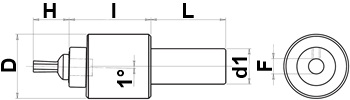
Cylindrical fitting - Technical dimensions
| d1 (mm) | l (mm) | L (mm) | D (mm) | F (mm) | H (mm) |
|---|---|---|---|---|---|
| 20 | 76 | 50 | 58 | 16 | 40 |
| 25 | 76 | 50 | 58 | 16 | 40 |
| 25.40 | 76 | 50 | 58 | 16 | 40 |
| 30 | 76 | 50 | 58 | 16 | 40 |
| 31.75 | 76 | 50 | 58 | 16 | 40 |
| 32 | 76 | 50 | 58 | 16 | 40 |
| 40 | 76 | 80 | 58 | 16 | 40 |
Feed per revolution - Materials and geometries
| Material to be worked | Hexagons < 14 mm | Hexagons > 14 mm | Squares < 12 mm | Squares > 12 mm | Torx < T25 | Torx > T27 |
|---|---|---|---|---|---|---|
| Magnetic soft steel - Structural steel, case carburizing steel, free cutting steel (AVP) Rm < 700 N/mm² |
0.10 | 0.08 | 0.06 | 0.04 | 0.10 | 0.08 |
| Plain carbon steel - Alloyed steel - heat-treatable steel, steel castings Rm 700 ÷ 850 N/mm² |
0.08 | 0.06 | 0.05 | 0.03 | 0.08 | 0.06 |
| Alloyed steel - heat-treatable steel - nitriding steel - steel casting Rm 850 ÷ 1200 N/mm² |
0.06 | 0.03 | 0.03 | 0.02 | 0.05 | 0.03 |
| Alloyed steel - high strength steel Rm 1200 ÷ 1400 N/mm² |
0.02 | 0.02 | 0.02 | 0.02 | 0.03 | 0.02 |
| Free machining stainless steel - austenitic stainless steel Rm < 850 N/mm² |
0.08 | 0.06 | 0.04 | 0.03 | 0.08 | 0.06 |
| Ferritic - ferritic + austenitic - martensitic stainless steel Rm > 850 N/mm² |
0.04 | 0.03 | 0.03 | 0.02 | 0.04 | 0.03 |
| Lamellar grey cast iron Rm < 600 N/mm² |
0.11 | 0.08 | 0.07 | 0.04 | 0.11 | 0.08 |
| Lamellar grey cast iron - nodular cast iron - malleable cast iron Rm 600 ÷ 1000 N/mm² |
0.07 | 0.05 | 0.04 | 0.03 | 0.07 | 0.05 |
| Aluminium long chipping Rm < 500 N/mm² Si < 10% |
0.14 | 0.10 | 0.10 | 0.08 | 0.14 | 0.10 |
| Aluminium short chipping Rm > 500 N/mm² Si > 10% |
0.10 | 0.08 | 0.08 | 0.06 | 0.10 | 0.08 |
| Copper - soft brass long chipping Rm < 700 N/mm² |
0.12 | 0.09 | 0.10 | 0.08 | 0.12 | 0.10 |
| Copper - hard brass short chipping Rm < 700 N/mm² |
0.08 | 0.06 | 0.07 | 0.05 | 0.08 | 0.06 |
| Titanium unalloyed Rm < 700 N/mm² |
0.06 | 0.03 | 0.03 | 0.02 | 0.05 | 0.03 |
| Titanium alloys Rm > 700 N/mm² |
0.03 | 0.02 | 0.02 | 0.02 | 0.03 | 0.02 |
Preparation for broaching / drilling - Internal broaching
| Condition | Hexagonal seats | Square seats | Torx seats |
|---|---|---|---|
| < 14 mm and similar | Oversized drilling approx. 1% - 3% | Oversized drilling approx. 3% - 7% | — |
| > 14 mm and hard materials | Oversized drilling approx. 5% | Oversized drilling approx. 10% | — |
| > 21 mm | Oversized drilling approx. 5% - 10% | — | — |
| > 17 mm | — | Oversized drilling approx. 15% | — |
| T5 | — | — | D1.00 (-0.00 +0.05) |
| T6 | — | — | D1.40 (-0.00 +0.05) |
| T7 | — | — | D1.55 (-0.00 +0.07) |
| T8 | — | — | D1.90 (-0.00 +0.10) |
| T10 | — | — | D2.20 (-0.00 +0.10) |
| T15 | — | — | D2.60 (-0.00 +0.10) |
| T20 | — | — | D3.00 (-0.00 +0.10) |
| T25 | — | — | D3.40 (-0.00 +0.10) |
| T27 | — | — | D3.75 (-0.00 +0.10) |
| T30 | — | — | D4.20 (-0.00 +0.10) |
| T40 | — | — | D5.00 (-0.00 +0.15) |
| T45 | — | — | D5.80 (-0.00 +0.20) |
| T50 | — | — | D6.70 (-0.00 +0.20) |
| T55 | — | — | D8.20 (-0.00 +0.20) |
| T60 | — | — | D9.80 (-0.00 +0.20) |
- Brand:
- TADAAH
- Typology:
- Internal broach