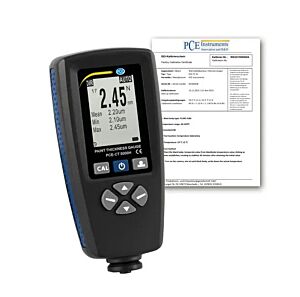
PCE Instruments PCE-CT 5000H Surface analyzer for non-destructive measurements on coatings of ferrous and non-ferrous metals, measuring range from 0 to 5000 µm
(Incl. Tax: €473.24)
PCE-CT 5000H surface tester for non-destructive coating thickness measurement on ferrous Fe and non-ferrous NFe metals. It measures from 0 to 5,000 µm with the Fe probe and from 0 to 3,000 µm with the NFe probe, with ±(2% + 1 µm) accuracy, internal memory, limit values, alarm function, USB data transfer, 1 to 4 point calibration.


The PCE-CT 5000H surface tester is a professional instrument for non-destructive measurement of coating thickness on ferrous and non-ferrous metal substrates. It is designed to check paint layers, coatings, protective layers, galvanic coatings, surface treatments and technical films applied to steel, iron, aluminium, copper, brass and other compatible metallic materials. Its use allows the coating quality to be verified quickly without damaging the part, making it suitable for production quality control, incoming and outgoing inspection, maintenance, testing and technical assessment.
The device uses two different measuring principles depending on the base material. On ferrous metals Fe it works by magnetic induction, while on non-ferrous metals NFe it works by eddy current measurement. This dual measuring capability allows the instrument to manage different applications, offering flexibility when checking painted, galvanized, anodized, protected or surface-treated components. It is particularly useful when different materials are inspected in the same company or when coatings must be checked on various types of substrate.
The Fe probe offers a measuring range from 0 to 5,000 µm and is intended for checking non-magnetic coatings on ferrous substrates, such as paint, enamel, plastic coatings or protective layers applied to steel and iron. The NFe probe offers a measuring range from 0 to 3,000 µm and is designed to measure insulating coatings on non-ferrous metal substrates, such as aluminium, copper or brass. This distinction is important because it allows the technician to use the correct measuring method according to the base material, reducing the risk of incorrect interpretation of the measured value.
The specified accuracy is ±(2% + 1 µm), making the instrument suitable for process checks, comparative measurements, conformity inspections and industrial coating control. The resolution changes according to the measuring range: 0.1 µm from 0 to 99.9 µm, 1 µm from 100 to 999 µm and 0.01 mm above 1,000 µm. This resolution management allows thin coatings to be read in detail while maintaining practical display values when thicker layers are measured.
Before measuring, the instrument can be calibrated from 1 to 4 points or by zero-point calibration. Calibration is essential for reliable results, especially when working on different materials, surfaces with varying geometries or coatings with very different thicknesses. The product is supplied with an Fe calibration plate, an NFe calibration plate and five calibration standards, which are useful for preparing the instrument before inspection and periodically checking measurement consistency.
The limit value setting function allows minimum or maximum acceptance thresholds to be defined. If the measured value exceeds the set limits, the instrument shows an alarm indication. This function is particularly useful in quality control, incoming and outgoing goods inspection, production batch checks and component acceptance procedures, as it allows the operator to immediately identify coatings that are too thin, too thick or not compliant with the required specification.
The internal memory manages 4 data groups with automatic storage of up to 2,000 values. This makes the instrument suitable for repeated checks on several points of the same part or on series of components. The statistical function displays the number of measurements, average value, minimum value, maximum value and standard deviation. These data help the technician evaluate coating process stability, layer uniformity and possible variations between different areas of the surface.
The measuring units can be switched between µm, mm and mils, allowing the instrument to adapt to different operating habits, technical specifications or international documentation. Data transfer via USB interface and the included software allow measurements to be managed in a more organized way, which is useful when checks must be archived, reports prepared, results compared or inspection outcomes documented.
In practical applications, the tester is suitable for body shops, industrial painting, metal fabrication, protective coating inspection, surface treatment, electroplating, industrial maintenance, mechanical workshops, metal component production, testing of painted parts, and inspection of structures, machinery, plants and components subject to corrosion or surface protection requirements. It can also be used to quickly verify whether a coating layer has been applied uniformly, whether it meets the required thickness or whether non-homogeneous areas are present.
For correct use, the surface should be cleaned before measurement, avoiding points with dirt, oxide, residues, burrs or evident deformation. The probe should be kept stable and perpendicular to the surface. The minimum curvature radius should also be considered: 5 mm for convex surfaces and 25 mm for concave surfaces, with a minimum measuring area of Ø 20 mm. On very small, curved, irregular or complex parts, the measurement must be interpreted carefully because the shape of the component can affect contact stability and repeatability.
The instrument is not designed to measure heights, transmission clearances or geometric errors such as flatness, concentricity, parallelism or roundness. Its specific function is coating thickness measurement on metal substrates. However, in the technical inspection of a component, coating thickness can be a fundamental value together with other dimensional or geometric checks, because a coating that is too thick, too thin or not uniform can affect fits, surface protection, appearance, part durability and compliance with the customer specification.
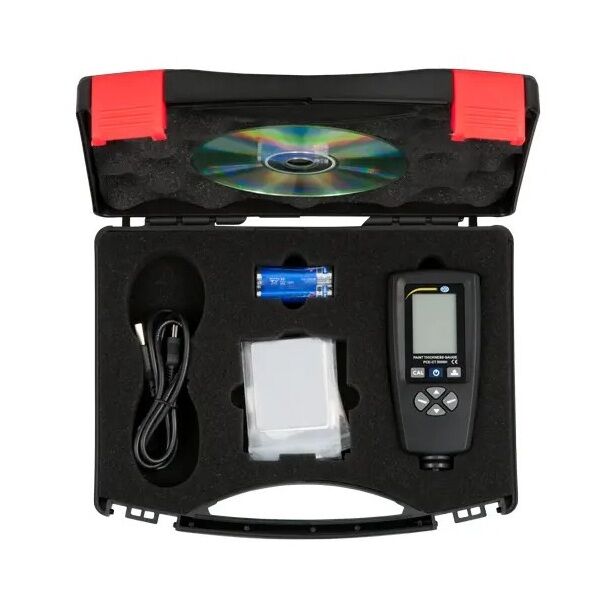
Delivery scope:
1 x PCE-CT 5000H Thickness Meter
2 x Zero calibration plates (ferrous and non-ferrous)
5 x Calibration plates
2 x 1.5V AAA batteries
1 x USB cable
1 x PC-compatible software
1 x User manual
1 x Carrying case
PCE-CT 5000H - Coating Thickness Gauge for Fe / NFe Substrates
| Parameter | Value |
|---|---|
| Model | PCE-CT 5000H |
| Fe measuring principle | Magnetic induction |
| Fe measuring range | 0 ... 5,000 µm |
| Minimum Fe substrate thickness | 0.02 mm |
| NFe measuring principle | Eddy current |
| NFe measuring range | 0 ... 3,000 µm |
| Minimum NFe substrate thickness | 0.05 mm |
| Accuracy | ± (2% + 1 µm) |
| Resolution | 0 ... 99.9 µm: 0.1 µm / 100 ... 999 µm: 1 µm / >1000 µm: 0.01 mm |
| Calibration | 1 to 4 points + zero calibration |
| Memory | 4 data groups, max. 2,000 readings |
| Statistical functions | Average, minimum, maximum, standard deviation |
| Units | µm, mm, mils |
| Alarm function | Programmable limit values |
| Minimum convex radius | 5 mm |
| Minimum concave radius | 25 mm |
| Minimum measuring area | Ø 20 mm |
| Sampling rate | 2 readings/s |
| Interface | USB |
| Power supply | 2 x 1.5 V AAA batteries |
| Menu languages | English, German, Russian, Chinese |
| Operating conditions | 0 ... +50 °C, 20 ... 90% RH |
| Storage conditions | -10 ... +60 °C |
| Standards | CE, RoHS, FCC |
| Dimensions | 110 x 53 x 24 mm |
| Housing material | ABS |
| Weight | 92 g |
- EAN Code:
- 4250348717276
- Typology:
- Digital thickness gauge
- Brand:
- PCE INSTRUMENTS
- Measurements range:
- 0 - 5000 µm