PCE Instruments PCE-2500N-ICA Portable hardness tester for metals with impact device, internal memory, USB interface and ISO certification included
(Incl. Tax: €1,064.94)
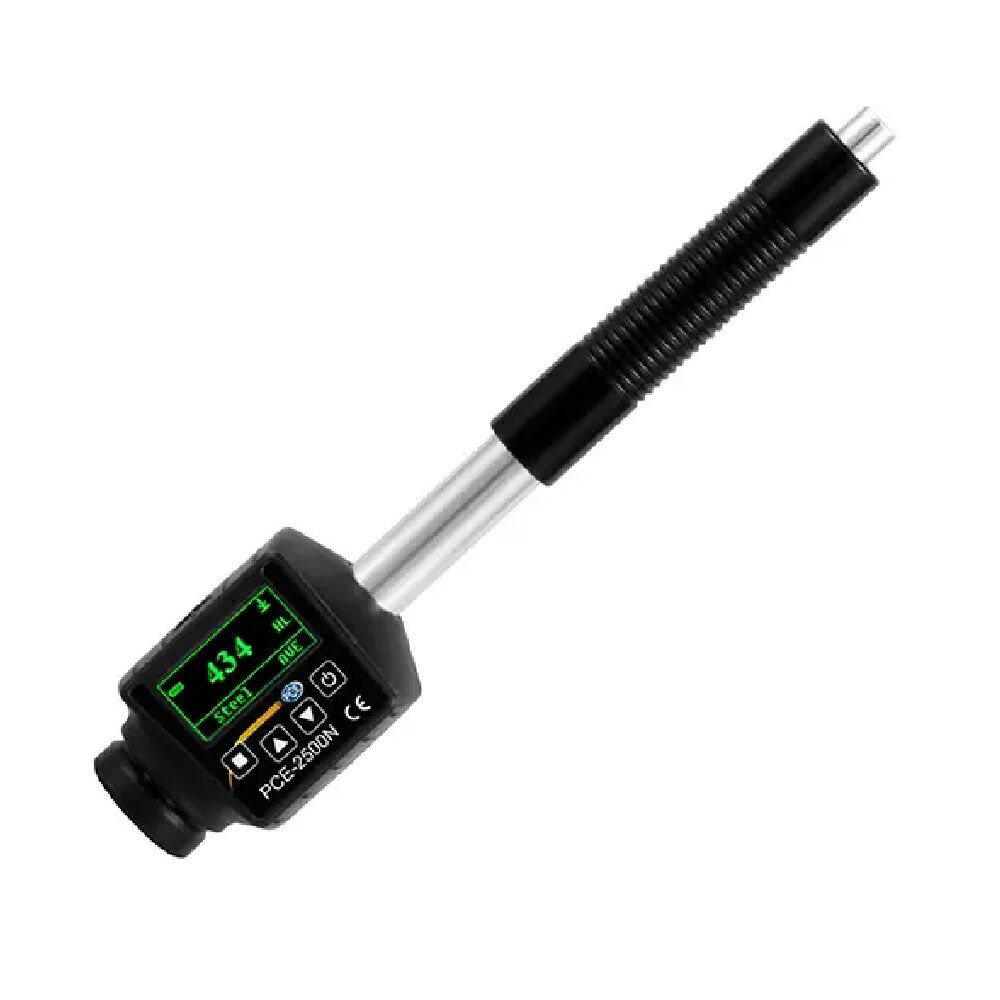
The PCE-2500N-ICA hardness tester is compact and easy to use, with dimensions similar to a pocket pen. The portable mode allows measurements anywhere. It uses a rebound impact device to obtain non-destructive values, shown on the display. Compatible with HRC, HRB, HRA, HB, HV and HS units, measures steel, alloys, cast iron, aluminium, brass and bronze. Includes internal memory, but values are not transferable to PC. The D-type impact device calculates hardness based on rebound.

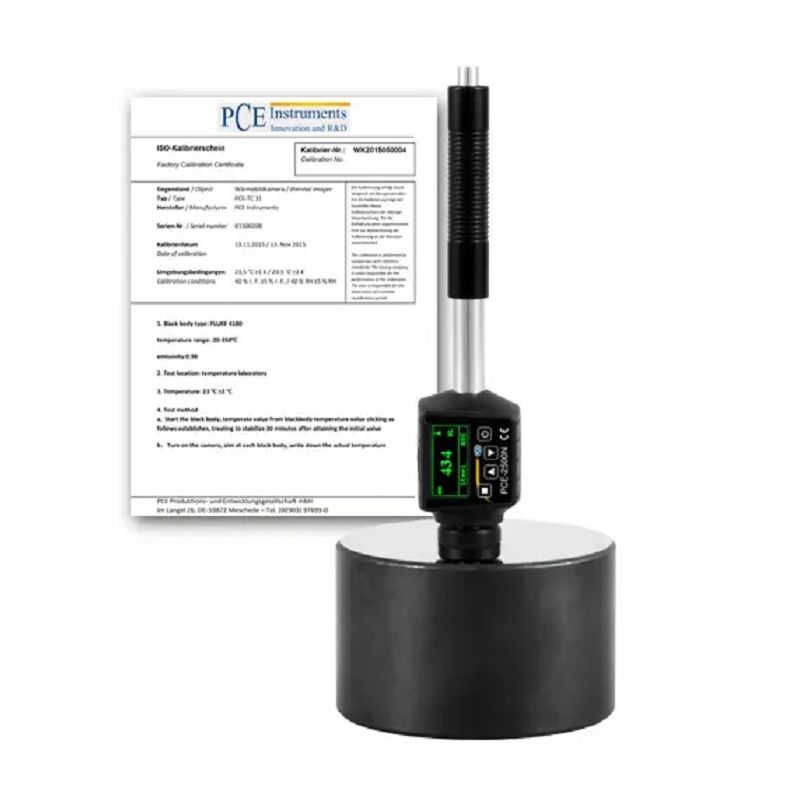
- ISO certification included
- Measures most common units of hardness
- Wide measuring range
- High accuracy
- Instant reading on the display
- Allows measurement in various positions
- Uses D-type impact device
- Allows measurement on different types of metal
- Lithium battery
- USB cable for battery charging
- Internal memory
| Measuring ranges | HLD: 170 ... 960 HRC: 17.9 ... 69.5 HB: 19 ... 683 HV: 80 ... 1042 HS: 30.6 ... 102.6 HRA: 59.1 .. 88 HRB: 3.5 ... 101.7 |
| Measurement accuracy | HLD: ± 0.5% |
| Measuring principle | Rebound method |
| Impact device | Type D striker |
| Display | 128 x 64 OLED |
| Repeatability | HLD: ± 0.8% |
| Hardness max. | 1042 HV |
| Measurement units | HLD, HRC, HB, HV, HS, HRA, HRB |
| Running time | Approx. 10 hours of continuous use at full charge |
| Power supply | Rechargeable Li-ion battery |
| Storage conditions | -30 ... 60°C / -22 ... 140°F, <90% RH |
| Operating conditions | -10 ... 50°C / 14 ... 122°F, <90% RH |
| Dimensions | 148 x 32 x 25 mm / 5.83 x 1.26 x 0.99 in |
| Limit alarm | Yes |
| Automatic shutdown | Yes |
| Weight | 650 g / 1.44 lbs |
| Materials | Steel -Cast steel - Alloyed tool steel - Stainless steel - Cast iron -Ductile iron - Aluminium alloys - Brass - Bronze - Copper |
| Measuring ranges on various material surfaces | |
| Steel | HRC: 17.9 ... 68.5 HRB: 59.6 ... 99.6 HRA: 59.1 ... 85.8 HB: 127 ... 651 HV: 83 ... 976 HS: 32 , 2 ... 99.5 |
| Tool steel | HRC: 17.9 ... 68.5 HRB: 59.6 ... 99.6 HRA: 59.1 ... 85.8 HB: 127 ... 651 HV: 83 ... 976 HS: 32 , 2 ... 99.5 |
| Stainless steel | HRB: 46.5 ... 101.7 HB: 85 ... 655 HV: 85 ... 802 |
| Cast iron | HB: 93 ... 334 |
| Brass | HRB: 13.5 ... 95.3 HB: 40 ... 173 |
| Bronze | HB: 60 ... 290 |
| Copper | HB: 45 ... 315 |
1 x Hardness Gauge PCE-2500N-ICA
1 x Percussor type D
1 x Brush
1 x Control block
1 x Carrying case
1 x ISO certification (English/German, rebound according to Leeb, 3 measuring points: approx. 490 HLD, 660 HLD, 780 HLD)
Operating instructions (available as download)
Penetration Testers: These use a penetrator pressed onto the material's surface. The depth or area of the resulting indentation is measured to calculate hardness. Common methods include:
- Rockwell Method (HRC, HRB, HRA): Uses a diamond cone or a steel ball to make the indentation. Widely used - for steels and alloys.
- Vickers Method (HV): Employs a diamond pyramid and can be applied to a wide range of materials, including metals and ceramics.
- Knoop Method (HK): Similar to Vickers but with a prismatic penetrator, suitable for brittle or thin materials.
Rebound Testers: Measure hardness based on the rebound energy of an impact on a material. They are particularly useful for field measurements and various types of materials. An example is the PCE-2500N-ICA rebound hardness tester, which provides non-destructive and portable measurements.
-
Metallurgical Industry: Essential for quality control during the production and processing of metals. Hardness of materials such as steel, steel alloys, and stainless steel is measured to ensure they meet technical specifications and safety standards.
-
Manufacturing Sector: Here, hardness testers help ensure that components and parts produced have the necessary hardness characteristics to function properly without excessive wear or breakage.
-
Research and Development: In research laboratories, hardness testers are used to develop new materials and improve existing ones by analyzing mechanical properties and performance under various conditions.
-
Automotive and Aerospace: Materials used in these sectors must have specific hardness to ensure safety and performance. Hardness testers are used to test components like gears, shafts, and structural parts.
-
Construction and Building: In construction, it is important to test the hardness of building materials such as concrete and metals to ensure they meet quality and durability standards.
-
Non-Destructive Measurements: Some methods, such as those based on rebound, allow measurements to be made without damaging the material, making them ideal for testing finished parts and materials in production settings.
-
Portability: Tools like the PCE-2500N-ICA are designed to be compact and easily portable, facilitating field measurements and use in non-stationary work environments.
-
Versatility: Testers can be used on a wide range of materials and can be adapted to measure different types of hardness depending on requirements.
- EAN Code:
- 4250348728128
- Typology:
- Digital hardness tester
- Brand:
- PCE INSTRUMENTS
- Measurements range:
- 17.9 - 69.5 HRC