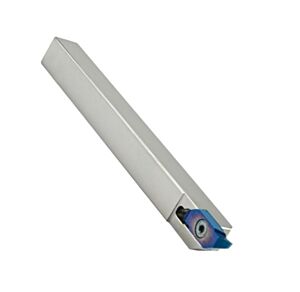
CARMEX Left hand Swiss line left insert made of GX7-coated hard metall micrograin, size 25, for snap ring groove DIN 471-472 for shafts performed plunge on CNC and sliding headstock lathes snap ring thickness of your choice
(Incl. Tax: €56.61)
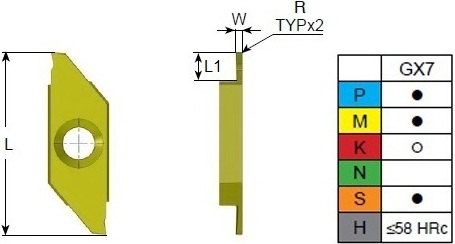 Slot-making inserts for external stop rings are designed for a specific design housing. External stop rings are mechanical components used to secure rotating or sliding elements on cylindrical surfaces, finding application in various industries. In the automotive industry, these rings secure gears, bearings and pulleys on drive shafts. They are also used in suspension, steering, and brake systems. In aerospace, they are crucial for fastening components in transmission and flight control systems. Also, in the field of industrial machinery, they find application for fastening gears and pulleys on shafts.

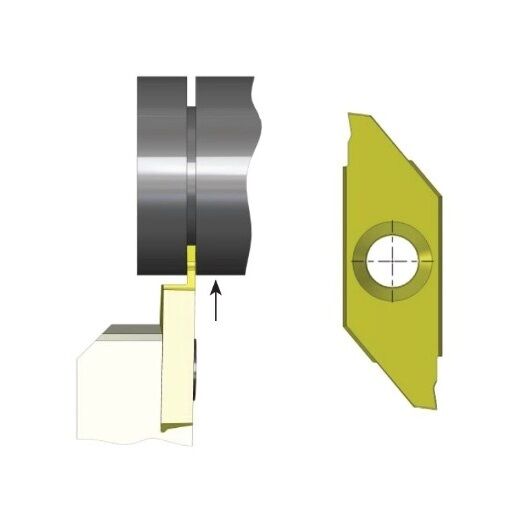
The inserts used for creating the grooves to house the retaining rings are manufactured with a pre-calculated thickness to ensure a precise fit for the external retaining rings.
External retaining rings, also known as external circlips or external snap rings, are mechanical components widely used to secure rotating or sliding elements on transmission shafts or other cylindrical surfaces. Thanks to their ability to provide reliable and easy-to-install fastening, they find applications in numerous industrial and engineering sectors.
In the automotive sector, external retaining rings are used to secure gears, bearings, pulleys, and other components on engine or transmission shafts. They are also employed in suspension systems to lock pins or joints, in steering systems to maintain the position of rotating components, and in brakes and clutches to secure discs or drums. In the aerospace industry, these rings are essential for securing rotating components in turbine engine shafts and flight control systems, where safe and precise fastening is critical.
In the field of industrial machinery, external retaining rings are used to secure gears, pulleys, or bearings on the transmission shafts of machine tools, robotics, pumps, and compressors. In robotics, for example, they are used to lock rotating components in robotic arms or actuators, while in pumps and compressors, they keep shafts, impellers, or other rotating elements in place. In the electronics and mechatronics sector, these rings are used in electric motors, where they secure rotors, bearings, or other components on the shafts, and in motion transmission devices such as timing belts, chains, or pulleys.
In the railway sector, external retaining rings are used to secure components on the transmission shafts of trains or locomotives, as well as in suspension systems to lock pins or joints. In the marine sector, they are employed to secure propellers, engine shafts, or transmission system components, and in control systems to lock rotating components in ship steering mechanisms. In the energy sector, these rings are essential for securing rotating components in wind turbine shafts or hydroelectric plant impellers.
In the agricultural sector, external retaining rings are used to secure rotating components in tractors, combine harvesters, and other agricultural equipment, as well as in transmission systems to lock gears or pulleys. In the medical sector, they find applications in equipment such as infusion pumps or imaging systems, where precise and reliable fastening is required. Finally, in the household appliance sector, these rings are used to secure rotating components in the motors and transmissions of washing machines, dryers, dishwashers, and other devices.
External retaining rings offer numerous advantages, including ease of installation and removal, reliability under conditions of vibration or high loads, and compactness, making them ideal for applications with limited space. Their versatility and reliability make them indispensable components in many industrial and mechanical contexts, where secure and easy-to-maintain fastening is required.
The BLU inserts designed and manufactured by Carmex are triple-coated inserts made from micro-grain materials, specifically developed for machining on CNC machine tools and sliding-head machines. These inserts are used for machining low- and high-carbon steels, stainless steels, steel alloys, and cast iron and steel castings. The coating and lapping of the cutting edge ensure that the micro-grain structure of the insert remains intact during chip removal operations. They are particularly well-suited for machining steel castings, austenitic stainless steels, stainless steel castings, and cast iron.
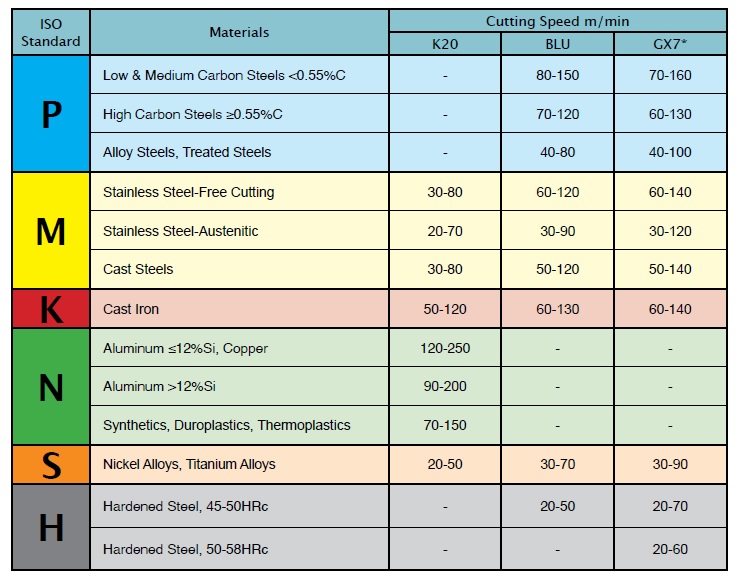
Parts manufactured using these inserts enable the production of turned valve components in the automotive and aerospace sectors, as well as precision-turned metal parts. The cutting speed parameters for the Carmex BLU insert are customized and calculated based on the material being machined.
As shown in the table, the cutting speed ranges between 40 and 130 meters per minute. The correct choice depends on several factors, such as the type of coolant used, the chemical composition of the material being machined, chip formation and control during material processing, depth of cut, and the condition of the machine. The feed rate of the tool largely depends on the desired surface finish and roughness of the part, as well as the depth of cut applied to the insert. A helpful guideline for selecting the correct feed rate is the constant monitoring of the temperature generated during chip removal and the efficient evacuation of chips from the machine tool's working area.
- Brand:
- CARMEX
- Cutting Material:
- GX7
- Typology:
- Grooving LH