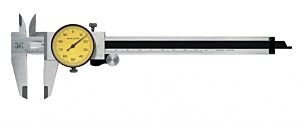
C2301502 Caliber with watch MicroMet Series, Cinquantisimal/Ventesimal - Depth rod - Measuring range of your choice
(Incl. Tax: €73.20)
The MicroMet dial gauges, with micrometric advancement wheel, are made of stainless steel and have a rack protected against dirt.
Supplied complete with case.
Norm: DIN 862


| Code | Measuring range (mm) | Resolution | Accuracy ± (mm) | Depth rod (mm) | Dia (mm) |
|---|---|---|---|---|---|
| 2301502 | 0 – 150 | 0.02 | 0.03 | 6.7 × 1.8 | 38.5 |
| 2302002 | 0 – 200 | 0.02 | 0.03 | 6.7 × 1.8 | 38.5 |
| 2303002 | 0 – 300 | 0.02 | 0.04 | 7.0 × 2.1 | 44.5 |
Dial calipers, also called dial calipers or clock calipers, are precision measuring instruments used mainly in the mechanical and engineering fields to measure lengths, thicknesses, internal and external diameters with great accuracy. Compared to traditional vernier calipers (or vernier), these models have a dial with a clock with hands that allows for easier and more precise reading, often with resolutions up to one hundredth of a millimeter.
Main features:
Dial with hand:
The clock dial facilitates the reading of the measurement, eliminating the manual interpretation of the vernier.
The hand rotates inside the dial and directly indicates the measurement in fractions of a millimeter, usually with a resolution of 0.02 mm.
Precision and accuracy:
Generally more precise and easier to read than vernier calipers.
They are used in applications where a faster and easier to read measurement is required than the classic analog vernier system.
Construction:
Like other calipers, they consist of two movable jaws that measure outside and inside diameters.
The jaws are moved by a slider that moves the dial pointer.
They often include a depth rod to measure cavities or recesses.
Measurement modes:
External measurement: using the outside jaws.
Internal measurement: using the smaller inside jaws.
Depth measurement: using the depth rod.
Common uses:
Industries such as machine building, engineering and precision parts manufacturing.
It is used for quality control during the machining of parts, where tolerances are critical.
Advantages over other calipers:
Easy to read: The dial provides a clearer view than vernier calipers, reducing reading errors.
Speed: Quicker to use than digital calipers, as it does not require an electronic display to be turned on and does not rely on batteries.
Using a watch caliper is fairly simple, but requires care to ensure accurate measurements. Here is a step-by-step guide on how to use it correctly:
Checking the tool
Before you begin, it is important to check that the caliper is in good condition:
Make sure that the dial pointer is positioned exactly at zero when the caliper jaws are fully closed.
Make sure that the caliper is clean and free of dust or debris, especially on the measuring surfaces.
Zero the caliper
Close the caliper jaws completely.
If the pointer does not align with the zero on the dial, use the fine adjustment wheel (if available) to zero the dial. This will ensure that the measurement will start correctly from zero.
Measuring an external object (outside diameter, width, thickness)
Opening the jaws: Move the slider to open the caliper jaws. Make sure to open them enough to accommodate the object you are measuring.
Positioning: Position the outer jaws of the caliper around the object.
Closing gently: Slide the slider to close the jaws gently on the object, without applying too much pressure (which could deform the object or distort the measurement).
Reading the measurement: The pointer on the dial will indicate the precise measurement. The main part of the measurement is read from the caliper scale (for example, 10 mm), while the hundredths or thousandths of a millimeter are indicated by the pointer on the dial (for example, 10.23 mm).
Measuring an inside diameter
Opening the internal jaws: Move the slider to open the internal jaws of the caliper.
Inserting into the object: Insert the internal jaws into the object you wish to measure (for example, the inside diameter of a pipe or a hole).
Gently expanding: Slide the slider to open the jaws until they gently touch opposite sides of the object.
Reading: Read the measurement on the dial and the main scale.
Measuring depth
Placement: Place the base of the caliper on the top edge of the object you wish to measure in depth.
Opening the depth rod: Slide the slider down so that the depth rod extends into the object.
Measurement: Continue moving the cursor until the rod touches the bottom of the hole or cavity.
Reading: Read the measurement from the scale and dial.
Interpreting the Reading
Main Scale: The main part of the measurement (millimeters) is indicated on the linear scale along the body of the caliper.
Dial: The dial indicates the most precise part of the measurement, usually in hundredths of a millimeter (0.01 mm). The pointer rotates as the cursor moves, adding precision to the reading.
Close the caliper
After taking the measurement, gently close the jaws of the caliper and clean the instrument
- Brand:
- RUPAC
- Typology:
- Dial caliper